Sunday, 11 August 2019

Foreign Language Films 10 & 11: Ip Man (China, 2008); La Vie en Rose (France, 2007)

Ip Man


Plot Intro

Unassuming martial arts expert Ip Man (Donnie Yen) and his wife Cheung Wing-Sing (Lynn Hung) lead a quiet life in Foshan during the 1930s. But when a group of outsiders arrive and attempt to assert their authority by defeating and humiliating all the martial arts school leaders, Ip Man is forced to prove his prowess to save his city from disgrace. And then the Japanese invade…

Paul says...


Here’s a rollicking, fast-paced fight fest that will spoon-feed you the entire plot on those sleepy, takeaway-fuelled Saturday nights. Ip Man is actually the first in a series of films which, together, chart the life of the titular character, who was not only a real life Wing Chun grandmaster, but was also Bruce Lee’s teacher. The critical acclaim it achieved on release has led to the successful production of two sequels, and another fourth instalment is being released this year. 

Admittedly, it wasn’t quite the historical biopic that Wikipedia made it out to be. It only charts a few life events between the the mid '30s and early '40s, so there is no reference to Bruce Lee except in the closing statements. It’s actually not that historically accurate and most of Ip Man’s actions were made up. And the Japanese are presented as such a one-dimensionally sinister embodiment of evil that they make the Brexit Party look like Yul Bryner’s children in The King And I. Really, it’s a martial arts action-movie that’s inspired by some elements of history.

But it’s bloody entertaining stuff. The fight scenes (and there are many of them) are intricately and spectacularly choreographed, and they get more and more inventive as the film progresses. Starting with Ip Man’s cool-headed defeat of a hot-headed challenger, leading into his frantic defeat of 10 Japanese henchmen at once, and culminating in his training of a group of factory workers who eventually use their new-found skills for inspirational and often comical effect. The film never loses momentum, and I spent all the intermediary scenes looking forward to the next battle.

The film also boasts strong performances from Donnie Yen, who acts with calm but authoritative charisma, and also from Lynn Hung as his stoic and strong-headed wife. The film cleverly ends on something of a cliffhanger too, which left me eager to check out its sequels, although I’m not sure they have lived up the success of the first instalment.


At just 108 minutes, the film is far from “epic” and it does have the historical insight of a Jacob Rees-Mogg novel. But it’s an involving, inventive and invigorating thrill-ride. Is it the finest example of Chinese cinema? I suspect not. Would I watch it again? Hell yes. And I might break a few vases trying out the battle moves.

Highlight 
Pick a battle scene. Any battle scene! 

Lowlight 
The depiction of the Japanese is….well, if it’s not “racist” it’s at least Chinese nationalist propaganda.  

Mark 
8/10


Doug says...
There’s a lot to be said for a film that packs in lots of gripping action scenes, has a crack at some characterisation and keeps it all under two hours. I enjoyed Ip Man vastly, and it’s the perfect film to wind down with at the weekend. Thinking is not a requirement, as they spell out the goodies and baddies immediately (the baddies are all Japanese caricatures with tiny glasses and teeth and generally ‘cruel’ demeanours). 

I do have to say, it made me google whether there’s still anti-Japanese feeling in China and apparently it’s absolutely rife. Whether stirred up by the government or no, about 75% of the Chinese population actively dislike the Japanese, according to a recent poll. If even half of this film is true, it’s not difficult to see why. It’s all very Handmaid’s Tale with the invading Japanese forcing the Chinese to fight each other for their amusement, and occasionally shooting them as the fancy takes them. 

Biographically I’m sure it’s not at all correct, but why let that spoil a good film? I liked Donnie Yen’s calm portrayal of the eponymous hero, the stillness with which he acts makes his quick moving fight scenes all the more thrilling. A sort of Mrs Danvers of the Wing Chun world. I’d’ve liked to have seen more from his wife, but the actress still manages to convey the general annoyance that having a martial-arts-fanatic for a husband could hold. 


I’d watch the sequels, if only for more of the same. But in terms of artistic merit, I doubt it has much staying power. But this is cracking entertainment and sometimes that’s more than enough for a good evening in. 

Highlight
I particularly liked the fight scene as Ip Man fights off ten men in one go and then forgoes the reward of ten bags of rice. It’s beautifully lit and cheerfully uncomplicated. 

Lowlight
I thought it felt oddly rushed towards the end, particularly with a set of titles quickly telling you about the rest of Ip Man’s life. If they knew they were doing sequels why bother? 

Mark
8.5/10


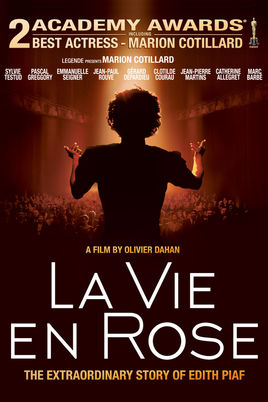
La Vie en Rose


Plot Intro

A non-linear dissection of the life of Edith Piaf, one of France’s greatest national treasures.


Paul says...


A lot was hanging on us watching this film. It’s Doug’s absolute favourite (he’s told me enough times that it is, anyway) and if I gave it anything lower than an 8 we’d be in marriage therapy quicker than a Kardashian couple.

Thankfully, this was a moment where our tastes in art intertwined. La Vie En Rose is utterly superb. It’s one of those films where the tone, the structure, the direction, script, acting work like a jigsaw puzzle in that they all slot together with mind-boggling intricacy to create a magnificent, gorgeous, slightly-surrealist whole.

The biggest selling point, for me, is Marion Cotillard as Piaf herself. She won the Best Actress Oscar for this and it’s one of the very few foreign-language performances to do so. She is totally unrecognisable, and utilises her entire body to encapsulate the way Piaf walked, moved and talked whilst also conveying a sense of heart-rending pity and admiration of this extraordinary woman. Even in youth, Piaf had an awkward, hunched, and jittery gait to her that got worse and worse as she aged and faced horrendous ill health. I felt so sorry for her right from her childhood where her father left her at her grandmother’s brothel to live, then reappeared years later to take her away again; to her life desperately trying to pay rent by singing on the streets; to her doomed affair with a married man; to her painful, sickly dying days at the tender age of 47, played with climactic gusto to the rousing trumpets of her most famous song, Non, Je Ne Regrette Rien. This complex finale reminds us that Piaf worked so hard in her difficult life, that she regrets nothing, but ultimately her life was still a tragedy.


I won’t gush anymore than that. Movie reviews are boring when there’s nothing to criticise. Just rest assured, no matter what your attitude may be to foreign-language films, or biopics, or French cinema, this is a film that will lift you up and tear at your heartstrings.

Highlight 
There are many things to choose from. But the one-shot scene in which Piaf receives horrible news about her lover, then, in a dream-like state, runs through a door onto a stage to keep her star-status going despite her heartbreak, is a stunner.

Lowlight
Rien!

Mark 
10/10


Doug says...

This is one of the greatest films ever made in the history of cinema. 

Now we’ve got that out of the way, let’s talk about why. The first reason is Marion Cottillard. She effortlessly shows you the same woman from her late teens through to her death. It’s a physical masterclass in how to subtly show the ravages of a drug-addled existence, even at her most glamorous there is a hunch in her shoulders, and by the end she can barely bend her spine away from the floor to look at someone. She is utterly unrecognisable. Everyone else in this film sees this - it feels like every actor is bringing their A-game purely to stay visible. 

Cottillard is also just extraordinarily charismatic. As she declares in one scene, when told she can’t do something, ‘I can’t? Then what the point of being Edith Piaf?’ It’s a triumphant, Icarus-flying-to-the-sun, champagne-fuelled performance. And yet, despite her tragic end, we’re left uplifted by the idea of this glorious, forceful personality. 

And that’s the second reason why this is so good. Director Olivier Dahan doesn’t play a Hollywood game. This is a non-linear film that rather than show the decline of Piaf, shows you all of her at once, at every age. A scene of her as a young girl being abandoned by her father is followed by another of her at the height of her power recording ‘Padam’ in a glossy recording studio. Her stumbling - jaundiced - to a nurse chair, is followed by her attracting suitors at parties and stealing the focus from all other party-goers. This is Piaf, all at once, immediate and unstoppable. 

And then there’s the third reason. Because on another level this goes beyond a biography. At the very end, as Piaf lies on her dying night in bed, she remembers scenes and people that we have seen all the way through. Only here, the ‘vie en rose’ - or we might say ‘rose tinted glasses’, are gone. The protective prostitute of her youth is seen instead drunkenly dazed at the edge of a party. Her cruel father is shown to have actually given her a doll. A whole tragic episode from her teenage years is suddenly alluded to. 

What Dahan is doing - so extraordinarily - here, is examining the very idea of memory. How a person can be constructed of fragments and perceptions, non-linear and gathered from any and all periods of their lives. And yet these fragments can be wrong, or seen without a full understanding. He enforces this practically, with metaphorical shots like Piaf weeping in a corridor and opening a door and suddenly being on stage, and other huge tracking shots. One follows Piaf as she walks through her apartment, other people drawn into and then expelled from her wake - one plays a song, another begs her to be on time. Through this sense of time and memory, we gain the sense of a person intent unconsciously on destruction. The scene when she expels her greatest friend and supporter Momone is done so casually and with such cruelty that it’s hard to stand Piaf in that moment. And yet you do. 


The film concludes with Piaf’s best known song Non, je ne regrette rien. And the true power of Dahan and Cottillard’s work here is that when you hear the lyrics, they apply so thoroughly to Piaf’s madcap, whirlwind life, that the effect is breath-taking. When the song ends, even though you know she dies a handful of years later, Piaf in her inescapable pursuit of love, power and success seems invincible. 


Highlight 
Towards the end, Piaf is interviewed on a beach by a young female journalist. Her answers are kind, poetic and lasting. ‘Do you like the dawn?’ ‘With a piano and friends.’ ‘Do you like the evening?’ ‘Ah for us, that’s dawn.’ It’s a beautifully played quiet moment amid the chaos, and really supports the idea of Piaf as a poetic, lonely soul. 

Lowlight
There is literally nothing. I will fight you. 

Mark 
100/10

Tuesday, 30 July 2019

79. The Departed (2006)


Plot Intro

A rookie Boston-based cop, Billy Costigan (Leonardo Dicaprio) is assigned by Captain Queenan (Matin Sheen) and Sergeant Dignam (Mark Wahlberg) to assume a new identity and infiltrate an Irish gang led by Frank Costello (Jack Nicholson). However, Costello has his own mole inside the police force, a man whose career Costello has influenced heavily, Colin Sullivan (Matt Damon). While Costigan and Sullivan both know that moles exist in opposing parties, neither knows the other’s true identity, and so a deeply complex game of cat-and-mouse ensues. 


Paul says...
The mid-noughties sees what one might call (and by “one” I mean “just me”) “the rise of the underdog”. We saw Crash controversially defeat Brokeback Mountain in our previous blog post. Soon, particularly in the 2010s, we will be seeing frequent examples in which the more unexpected Best Picture entries nab the prize from films with far higher production values. Gone are the days when Gone With the Wind, The Godfather, Ben-Hur and Titanic can get an easy win due to their insane popularity. I would argue that The Departed was such a win, as it beat a popular Clint Eastwood entry, Letters from Iwo Jima, and other delightful and incisive films, Little Miss Sunshine and The Queen.

The Departed certainly deserves its win far more than the previous year’s Crash, and it’s refreshing to delve back into the crime thriller, a genre not rewarded enough by the often-esoteric Academy. In fact, it’s heavily reminiscent of 1971's winner, The French Connection. Both films tackle the idea of blurred lines between “good” and “bad” when it comes to the police force’s relentless pursuit of catching criminals. Every police officer, even if they’re not associated with the mob, are a bunch of aggressive, toxically masculine arseholes, especially Mark Wahlberg’s bullish Dignam and Alec Baldwin’s bumbling Ellerby. There’s really no difference between the cops and the gang members they are chasing other than the latter doesn’t have the law on their side. Even the characters’ names sound symbolically similar, with Costigan and Costello being the main “hero” and “villain” respectively, and Costigan, Sullivan, Dignam and Queenan all blending into one when yelled out at high speed by sweaty middle-aged actors. This is a common trope of Shakespearean comedy and I assert that it is no coincidence that Shakespeare and literary references in general abound.

On top of this well-crafted insight into good and evil, The Departed also manages to tell an extremely complicated and fast-paced story with clarity- but, like many Scorsese films, you have to concentrate to keep up. Scorsese directs with his typically frenetic, emotionally-detached energy. He is obviously analysing but also laughing at most of these ridiculously aggressive characters. The dialogue is also snappy and to-the-point, and conversations that provide backstory are interspersed with images to provide vivacity in scenes that could have ended up being a bit dull. The cast are also impeccable. Nicholson is the most dynamic, but DiCaprio is typically transformative and I loved Damon doing such a strong Boston accent that he sounded like Peter Griffin. 

But where The Departed falls short of The French Connection is that it’s probably about 30-45 minutes too long. The intricacies of the story are complex, but the basic concept is not and it doesn’t rise much above DiCaprio trying to incriminate Nicholson while Damon steers him away whilst maintaining his trustworthy-cop status. There’s a strong pay-off at the end, again reminiscent of the shockingly inconclusive ending of The French Connection, but there are periods in the middle where I was tiring of the police having a chat before breaking into a fight, or Nicholson and DiCaprio exchanging tense dialogue that didn’t advance the plot. A quick edit could have had a faster, snappier film that didn’t lose it’s momentum mid-way. 


Nonetheless, this is one of the strongest Best Picture winners of the noughties and it rises above conventional crime-thrillers by throwing in plenty of narrative surprises and innovative direction to keep us entertained for the full 2.5 hours. But I’d say Wolf of Wall Street, Shutter Island and Gangs of New York are stronger examples of the lucrative Scorsese-DiCaprio collaboration. 

Highlight
I thoroughly enjoyed the first time DiCaprio and Damon make contact over the phone. It’s extremely quiet and tense and the film builds beautifully to this moment- and surprises us with its outcome.

Lowlight
There’s a couple of long scenes where DiCaprio and Nicholson talk tensely and it’s basically designed to keep us guessing about whether Nicholson will work out DiCaprio’s true identity but they go on too long and don’t change anything in the narrative.

Mark
7/10


Doug says...
I’ve not seen a Scorsese film before, and then randomly I very recently watched The Wolf of Wall Street, so I’ve had a bit of a crash course in his film making. I can safely say that while I admire the frenetic film-making and absorbing noir-esque storylines, I can’t help but feel this is a macho drugs/gun/general lawlessness obsessed film maker that doesn’t really appeal to me. 

The general theme of this at-times confusing film could be summed up by ‘being involved with the mafia is generally a bad thing.’ While this could seem an obvious lesson, I suppose it’s good to reiterate. One can imagine groups of Men Being Men would go see this and slap each other on the back and say ‘guns eh’ before making growling sounds. Or whatever it is that Men do. 

I’m not against the whole ‘male-focused’ films - indeed this project has introduced me to Clint Eastwood’s work and I’m very grateful for that. One wonders what Eastwood’s take on this film would have been - I’m willing to bet I’d have preferred it. 

But it’s not a bad film. It took me a while to understand what was going on, but it clicked about half an hour in and then watching the two ‘rat’ situations play off against each other was quite exciting. My blood wasn’t exactly racing - partly because I didn’t particularly care about any of the characters (again, they’re all stereotypes of Men which is just a bit dull) but I got involved. 

I’d be interested too to know if they made the film today whether they would still include all the homophobic language. I know that the case can be made for ‘creating a realistic copy of the environment’ but I also would prefer it if they didn’t spew homophobia on the big screen all the time. Anyone who sees this - despite it not glorifying the mob - could feel it’s ‘cool’ or ‘wild’ to mimic it and it doesn’t sit quite right with me. 

Acting wise, Jack Nicholson turns up and steals every scene with such effortless ease that one imagines Matt Damon and Leonardo DiCaprio were so awestruck that they forgot to try and match him. He’s a phenomenal actor and while not exactly subtle, he pours such energy and vigour into his role here - as always - that I enjoyed his scenes the most. 

Perhaps my favourite fact though is that according to Wikipedia, a sequel was planned. This is despite - as Wikipedia points out - ‘many of the key characters in the film are deceased by the movie’s end’. The sequel collapsed for financial reasons. 

Overall though, it’s about 45 minutes too long, and I’d be interested to see the original 2002 film Infernal Affairs, a Hong Kong movie that apparently is shorter - and by many accounts better. Not the best film in this project, but it’s dynamic enough and entertaining that the hours didn’t drag by. 


Also Paul just told me Shutter Island is one of his and I bloody loved that, but maybe it’s the exception to the Scorsese rule. 

Highlight
Jack Nicholson rocks up, steals every scene and then leaves. It’s the mark of a real Hollywood star, and it’s great to see his craft stay strong over the years. 

Lowlight
As I said, the homophobic slurs didn’t sit well with me, whatever Scorsese’s reasoning. 

Mark
7/10

Tuesday, 2 July 2019

78. Crash (2005)


Plot Intro

Several inter-linked stories study overt racism in modern-day Los Angeles. A wealthy white couple (Brendan Fraser and Sandra Bullock) have their car stolen at gun point by two black men (Ludacris and Larenz Tate). A Persian man (Shaun Toub) has his shop broken into and he blames the Mexican man (Michael Pena) who changed his door lock. A wealthy black couple (Terrence Howard and Thandie Newton) are victims of unnecessary brutality from two white police officers (Matt Dillon and Ryan Phillippe) when they are pulled over. And a black police detective (Don Cheadle) faces racism amongst the authorities whilst investigating a case.


Paul says...
We’ve come across films tackling racism a few times on this Oscar project. Gentleman’s Agreement, West Side Story, In the Heat of the Night and Driving Miss Daisy are some of the most notable. What connects them is the way in which the theme of racism was interweaved with their storylines to create something that, believably, could have happened in the periods they are set. Crash, on the other hand, dispenses with all subtlety, surprise and sensitivity. It’s not so much a commentary on racism but rather a full-blown, fully-armoured, full-frontal attack on racism. 

The fundamental message of Crash is that pretty much all characters, regardless of their race, are guilty of racism in some way, shape or form. The first scene portrays the initial “crash”, during which an Asian woman and a Salvadoran square off about which race is the worst driver and the entire 100 minutes pretty much carries on as it began. The “crash” of the title refers to a couple of literal car crashes that occur in the plot (and inevitably lead to two characters of different ethnic origins throwing horrendous insults at each other), but also the symbolic way in which we, as humans, are like particles floating around and crashing into each other every now and then. Don Cheadle waxes lyrical about this and the film emphasises that it is a shame these crashes culminate in anger rather than love. The only literal “crash” that does end in the latter is when Matt Dillon saves Thandie Newton, whom he disgracefully molested earlier in the film, from a burning car wreck. 

The enjoyable aspects of the film (and yes, there are a few) are the ways in which the characters interrelate. The film works full circle with Don Cheadle discovering a dead body on the side of the road and the plot explaining who this body is and how they are connected to Cheadle; minor characters pop up with unexpected connections to major ones; and unlikeable characters gain emotional life lessons from the most unexpected of places. 

But none of this can really detract from the fact that Crash is about as profound about racism as Kim Kardashian would be about the evils of vanity. Characters behave and interact in ways that are so extreme and sudden that it is hard to believe it. Ludacris and Larenz Tate rant incessantly about how they are treated like second-class citizens because they are black, then almost immediately afterwards, draw guns to rob Sandra Bullock. Characters in conflict go right in with the race card, yelling things like “You Mexicans can’t fucking drive!” or likening a Persian family to Osama Bin Laden without any preamble. One character even moans about black people to Don Cheadle then scoffs and says “Black people, eh?”- to a black man! 


I know that racism takes extreme and undisguised forms such as these. But they are shoehorned in with almost no effort from the script writer whatsoever. There’s also no exploration of the more underhanded, insidious forms of racism that have come to light. Critics went to town on the producers of Harry Potter and the Cursed Child for choosing a black actress to play Hermione (even though Hermione’s race is never mentioned in the books); Meghan Markle gets significantly more scrutiny than her white sister-in-law, Kate Middleton; and in which year was the first film featuring an a majority Asian cast released by a major Hollywood studio? It was 2018. All of this proves that though we may have shouted about equal rights in the '60s, and though the law may have changed in most of the Western world, there are still huge steps to take in order to combat institutionalised racism. And for all its moralising and liberal use of racial jibes, Crash, quite frankly, has not aided this cause in the slightest, while its opponent, Brokeback Mountain, remains a cornerstone in LGBT culture. 

Highlight
The scene in which Matt Dillon saves Thandie Newton from the burning car is pretty beautifully shot. The film seems to have been built around it, so its a shame it happens halfway through and the plot has to continue limping along.

Lowlight
The characters portrayed by Ludacris and Larenz Tate are by far the worst thought-out. They are disgruntled about being black in a white-dominated world and they are also criminals. But no exploration is put into why they have turned to crime, or what they think needs to change to aid the world. They have no voice in a film that should really have been about their victimisation.

Mark
2/10


Doug says...
‘I want to examine it. But I know it has no content’ - Oscar, ‘The Office’ (US) 

In 2018, the surprise winner of ‘Best Picture’ at the Oscars was Green Book, a film whose unsubtle attempts to argue racism was a nasty factor of eras gone by rankled heartily with me. ‘Look’, the film seemed to say, ‘wasn’t racism just the worst? Aren’t we glad it’s sorted now?’ 

It was a pretty shameful win, especially with the whiteness of the writers and directors. And many discussed how quiet about the whole thing Mahershala Ali was about the film when collecting his Best Supporting Actor win. Even he, people thought, thinks this is a pretty disgraceful film. 

But this is the problem with Hollywood. The writers and directors given the chance to create are mostly white, and if they decide to write about the subtleties of racism, no one seems to think of stopping them. It’s the same with Crash, where a white man wrote, directed and produced a film about how Racism Is Bad, and instead of being called out for a ham-fisted and obvious critique, he got showered in awards. 

The film is dire, and I’m not going to go into it, only to say Paul is entirely right. One can almost imagine writer, director and producer Paul Haggis enthusing about the scene where a white man says to a black man ‘black people, eh?’ Oh my, Haggis might have said at a dinner party, it’s a really interesting scene I’ve written and really addresses the subtleties of racism. 

Well it doesn’t. The most interesting film I’ve seen the Academy even nod at recently on the topic of racism was ‘Blackkklansman’ which was - guess what? - Directed By A Black Man. Imagine that? That the subtleties and intricacies of a highly complex and unsolved matter might best be spoken about by someone who has lived that life? Spike Lee’s take on racism is not the pat, easy one that Haggis or Green Book’s Peter Farrelly harp on about. It’s messy and it’s unfinished - something which these writers seem afraid of admitting. 


Anyway, I’ve had enough of talking about this piece of tripe, only to say Sandra Bullock - you were better than this. You are. Television is putting far more effort into diversity and it’s showing up Hollywood massively - in 2005 and in 2018. To quote Hannah Gadsby: pull your fucking socks up. 


Highlight
No.

Lowlight
This film. 

Mark
0/10