Sunday, 8 April 2018

44. The French Connection (1971)


Plot Intro

Two tough New York Police Detectives, Doyle (Gene Hackman) and Russo (Rod Scheider) start following a Suspicious Man called Sal Boca (Tony Lo Bianco). What they eventually discover is that Boca is tied into an elaborate operation in which a shipment of drugs are being smuggled into NYC from France, spearheaded by a French gangster named Charnier (Fernando Rey). The game of cat-and-mouse is on.

Doug says...

Oh dear, I don’t think I’m going to love the ‘70s. Last week was the abysmal Patton and this week is 1971’s thriller The French Connection. It’s a story about drug smuggling and French heroin dealers, with plenty of unrealistic car chases and a bad French man being chased by the still-not-good-but-less-bad American cops. 

So, I don’t hate it. It takes a long time to get going, and to be honest I couldn’t care less about any of the characters. But there’s a great scene on the train when a French baddie hijacks the train and the main policeman attempts to stop him, and there’s another bit in a nightclub where The Three Degrees (a Diana Ross-esque nightclub trio) sing a song ‘Everyone Gets To Go To The Moon’ with lyrics such as ‘it’s customary in songs like this to use words like spoon’. Beautifully surreal. 

The car chase scene (in the above mentioned hijacking of train) is considered the film’s highlight and it is a tremendous bit of cinematography. The camera is attached to the front of the policeman’s car (actually driven by stuntmen) which means that the cars that swerve out of the way and screaming nannies with prams that nearly get run over are real. It’s a great piece of footage - akin to the celebrated tracking shot in our very first film Wings (1927) which has a camera skim through multiple Parisienne couples at a cafe. 

But it’s not all great car chase scenes. I actually found the plot pretty dense and impenetrable at times. At one point there’s a sniper on the roof who randomly shoots a nanny dead. I’m still not sure why. And while I was able to figure out the ‘baddies’ and the ‘goodies’, I never quite knew any of their statuses or positions. And ultimately the film chooses to end quietly with no real catharsis. I felt this was because they were staying true to the real story (it’s based on a non-fiction book), but then I found out that the real story had far more resolution. 


And this feels like the issue. Like Midnight Cowboy, it’s trying to paint a grittier, ‘real’ picture of New York, but ultimately it becomes so fixated on showing you the grit that you end up not really caring about any of them. And while they may well be acting out against the sentimentality of the earlier decades, what transpires is that when you remove any semblance of heart from a film, you also remove the ability for viewers to stay interested. 


Highlight 
I did really enjoy the car chase scene. It was an engaging, thrilling piece of film work and is a really good example of how film can offer different things to theatre and other art forms.

Lowlight
I didn’t end up caring about any of the characters, and the captions at the film’s close wrapped up everything in a way that was meant (I think) to be melancholy, but actually came across a bit naff. 

Mark 
3/10 


Paul says...


Crime thrillers are something of a rarity at the Oscars. The Academy generally prefers to reward films with a strong social commentary and whilst crime films may point out that murder, drugs and assault are “bad”, they tend to place excitement over integrity and as a result, they become victims of the snobbery of prestigious award ceremonies. We’ve recently seen In the Heat of the Night, which tackled race relations in the same year that Martin Luther King got shot, and in the future we will be tackling The Silence of the Lambs and The Departed. But for now, I have one very big question to answer: why did The French Connection win?

To modern eyes, it’s a pretty simplistic crime film. Two policemen are chasing Bad Men. Classic 1990s equivalents such as the aforementioned Lambs and Se7en follow similar themes, but with some very intense character work. Se7en especially dissected Brad Pitt and Morgan Freeman to Freudian proportions, and the film in general had big things to say about the darkest recesses of the human condition. The French Connection initially doesn’t appear to explore that kind of territory. Gene Hackman, who won Best Actor for this, displays the most potential analysis. He embodies a brutish, obsessive, racist misogynist with gusto. I get the impression that the audiences of the '70s would have enjoyed his rebellious, no-nonsense approach to police work. But in the 21st century, where we are far more conscious of police brutality, particularly towards ethnic minorities in the US, it’s difficult to support a character who takes pleasure in randomly searching black men for drugs, and verbally abusing them when he finds out that he is mistaken. 

I think the film won due to its stylistic element- something which we are seeing more of as plot becomes less relevant, and atmosphere is the order of the day. Like Midnight Cowboy, this is a cold, grey, ugly New York City. It’s visibly rotting and the whole film climaxes in one of the most dilapidated abandoned warehouses I’ve ever seen in film. The Big Apple is rotten to the core. Unlike Midnight Cowboy, the film is furiously edited, and I really enjoyed this. There are numerous lengthy sequences in which the police pursue the criminals on foot, and the rapid pace, the montage-like effects and the attempts by both forces to out-do each other are heart-racingly intricate. The best is when Charnier and Doyle move in and out of a train, with Charnier blatantly aware that Doyle is on his tail, but Doyle sweating over keeping the French gangster within eye sight. It’s one of the most tense moments I’ve seen so far in this project.

Add to this the infamous car chase, and attack from a sniper and the climactic assault on the criminal ring, and we have a film that has taken crime thriller into new territory. The '60s was fraught with James Bond-style action flicks where the hero is smooth and faultless, the women are Amazonian and the villain is a sultry Soviet psychopath. The French Connection brought realism into the genre - the heroes are almost as unpleasant as the villains and lack Sean Connery’s good looks; the women are just as awful and the criminal are simply a bunch of snivelling, money-hungry drug-pushers. As violence steams ahead in film, Hollywood has taken audiences out of colourful escapism into the grit of real life, and I think The French Connection won because it is symbolic of this turning point.

To conclude, I return to my initial statement that the main character is hard to support because he is, to put it bluntly, a disgusting human being. Throughout the film, whilst being gripped by the cat-and-mouse chases, I was struggling to figure out whom I am supposed to be behind. Would '70s audiences really idolise such awful policemen? Or am I supposed to hate everyone? The final two minutes (and this is no exaggeration) answered my question. I won’t divulge what happens, but there a couple of extremely unexpected events that, for me, turned the entire film on its head and showed me exactly what this film is about. This is a film about a man’s obsession with catching a criminal, not out of good will to society but out of a terror of un-masculine failure. It’s an obsession that drives him too far - and leaves his final fate obscure and dark.


For me, that final two minutes sky-rocketed the film from a middle-of-the-road outdated thriller into a thoughtful and surprising piece of work. And whilst its lack of humour makes The French Connection a bit of an acquired taste, I thoroughly enjoyed it.


Highlight
The final 2 minutes threw me completely. I suggest that, even if you’re not enjoying the film much, focus on the plot and see if you change your mind at the last minute like I did.

Lowlight
I wasn’t massively convinced by the very ketchupy blood when people got shot. What is this, a media student’s film?

Mark
9/10

Monday, 2 April 2018

43. Patton (1970)


Plot Intro
It’s the height of World War II, and General George Patton (George C. Scott) is called in to command American troops stationed in Northern Africa, after a humiliating defeat in the Battle of the Kasserine Pass in Tunisia. His disciplinarian, tyrannical techniques prove controversial but (spoiler alert!) highly effective.

Paul says...

This is the first film since 1957’s high-scoring Bridge on the River Kwai to deal with the Second World War from the point of view of the soldiers. A lot has changed historically since then, and last week’s Midnight Cowboy displayed an attitude to America that was distinctly disenchanted and unpatriotic. So I was excited to see what a war biopic made at a time when the Vietnam War and Richard Nixon were under considerable fire had to say.

And Patton is extremely detailed. There are extensive explanations of army manoeuvres and internal politics between American, British and Russian commanding officers. Battles and events barely touched on in schools are re-enacted, and the attention to detail is so extreme that Scott even acted with the very ivory-handled pistols that Patton owned. Being a history geek, this had some appeal. I was interested in the same way that I would be interested if Louis Theroux were commenting on proceedings. 

But, and here’s the big problem with this film, it’s directed and written with such matter-of-factness and objectivity that it lacks heart. Did I feel anything at Patton’s various victories? Did I support him when he gave a rousing speech to motivate depressed soldiers? Did I hate him when he subjected some of them to nauseating abuse? No. I felt nothing. The film made no effort to bring historical events to life. They might as well have filmed a historical re-enactment society on a home camera and it would have the same effect. 

Another problem is the depiction of the central figure. Scott’s performance as Patton is the fulcrum around which the entire film revolves, and he’s vaguely memorable. I liked his calm-voiced menace when distributing orders, and his commanding of crowd scenes too. The famous opening speech which he delivers to the camera in front of a sprawling US flag has icon status and it’s probably the reason why he won Best Actor (he was the first actor to reject the award, calling the Oscars a “meat parade”). I was, however, expecting more complexity in the writing. Patton was jingoistic, egomaniacal and disgustingly unsympathetic to anyone he considered a coward. He slaps soldiers suffering PTSD, shoots farmers’ horses in the way of tanks, was convinced that he was the reincarnation of one of Napoleon’s army, and would have probably voted for Trump. The film depicts this but, surprisingly, maintains a sense of Patton being a hero - he gets all the speeches, all the glory, and I think we’re meant to laugh when he insults a Russian ally. History books (and by “books” I mean Wikipedia) will give you a far more ambiguous dissection of such a man. Bearing in mind that this was Richard Nixon’s favourite film, I get the sense that this film is not as critical of 1970’s politics as I hoped, and actually has nothing to say other than the usual Republican pro-American propaganda. 


Patton has won acclaim over the years, but I think this is from a predominantly American audience. It’s the same reaction that Darkest Hour has had from British critics- it’s a film about a national icon so it MUST be praised. I found it one-dimensional and slow-moving. But if you happen to share Britain First Facebook posts about respecting veterans, you’ll probably love it.


Highlight
The amusing scene involving some dogs - I’ll let Doug describe it in more delightful detail.

Lowlight
The battle scenes had so much more potential. Dunkirk, for all its faults, at least brought the audience into them so that you could not only see and hear it, but smell, taste and feel it too. Patton takes a more pedestrian approach and it doesn’t liven up the film no matter how much tanks get blown up.

Mark
3/10


Doug says...

I’ve been trying my best over the past couple of years - and especially in this project - to open up my mind and try and enjoy films I’d normally keep at arm’s length. And it has resulted in some delightful discoveries - Citizen Kaine was a fantastic film, and I found myself enjoying epics such as Lawrence of Arabia despite them being pretty far away from my usual viewing fare. 

But the one genre of film that I think I’m never going to warm to is war films. By war films I mean out-and-out, only-point-is-to-have-lots-of-gunfire, drawn out scenes where people talk about shooting each other, followed by scenes where the people shoot each other. And unfortunately for me, Patton is nearly three hours of the following: 

BANG CRASH BANG
[long technical scenes with really dull details and cardboard characters]
MORE BANG CRASH BANG
[more long technical scenes]
(Repeat ad infinitum)

So I dislike war films, this is a war film and nothing changed my mind. The main actor turns in I assume a good impression of Patton, but as Paul says, no one is likeable - or dislikeable. It’s incredibly dry and I spent most of the film on my phone, waiting for the dullness to end. 

What was good? Well, as Paul says, there’s a great scene with two dogs. And as I can’t be bothered to spend any more time talking about films with white army men wielding guns, here’s why the dog scene was so great. 

Firstly, Patton’s dog is a bull terrier, with the menacing glare, and Patton being your usual stereotype of toxic masculinity has decided he’s ‘William the Conqueror’ (don’t ask). But then he encounters a little fluffy poodle called Abigail. William snarls at Abigail, much to Patton’s pleasure, but then Abigail bears her teeth, growls right back and William slinks away, terrified. Patton renames him ‘Willie’ and Abigail’s little-old-lady owner approaches to apologise for Abigail scaring Patton’s big macho canine. 


Why is this scene great? Well, it’s not the best, but it’s the only scene I was remotely interested in, and featured two dogs, so I liked it. It just goes to show: if your film is dull, overlong and rambling on about Men With Guns (TM), you can always chuck a couple of dogs in and at least one of your scenes will be half bearable!


Highlight
Willie & Abigail, as above. I eagerly await a spin-off about their tempestuous will-they won’t-they relationship complete with cute puppies and a wise-cracking greyhound.

Lowlight
Yet another film about macho white men with guns, complete with millions of gunfights/bombs/etc etc. It’s so predictable and uninteresting that I had to immediately put on an episode of Ugly Betty to make sure the evening didn’t feel a waste. War films are my kryptonite. 

Mark
1/10

Saturday, 31 March 2018

The PAD Awards: 1960s

Our 1960s films, flanked by candlelight. (The Sound of Music is currently on loan to friends & made its apologies)


At the end of another decade, it's time for our decade-regular PAD (Paul and Doug) awards. So without first ado, our first award...

Least Favourite Film 

Paul says: My Fair Lady
I have, for the first time, done a “Douglas”. I have picked a least favourite film that DIDN’T have the lowest mark of the decade! Please save all gasps for the end of this paragraph. It would have been so easy to lambast Tom Jones’ lack of focus and Carry-On imitations. But I thought it would be deliciously controversial in a decade that has proven to be our most successful statistically to pick My Fair Lady. This is a film that promises a lot. It is one of the most successful stage and movie musicals of all time, and comes with a high regard even compared to its counterparts in the Golden Age of Movie Musicals. But for me, it’s too static, too slow, and too soulless. I’ve never been involved in whether Eliza Doolittle manages to enter high society or rebel against it, and I’ve always been unnerved by the romance between her and the snarky monster that is Dr Henry Higgins. Not one that has stood the test of time for me - but I know I’m in a lowly minority.


Doug says: Tom Jones

This was an appalling mess of a film - more ‘Carry On’ than ‘Academy Award Winning’ . Tom Jones rolls around having wild sexual adventures, and despite the interesting stylistic choices (exposition directly to camera, characters breaking the fourth wall), it had an amateurish tone that felt weird and irritating. Edith Evans valiantly did her best, but even her excellent turn couldn’t save this turkey of a film. (Dis)honourable mention also goes to In The Heat of the Night - a distinctly underwhelming winner. This wasn’t a decade of failures, but there were certainly a couple of flops. Tom Jones has been one of the forgotten winners - and with good reason. 


Favourite Male Performance 


Paul says: Paul Schofield in A Man For All Seasons
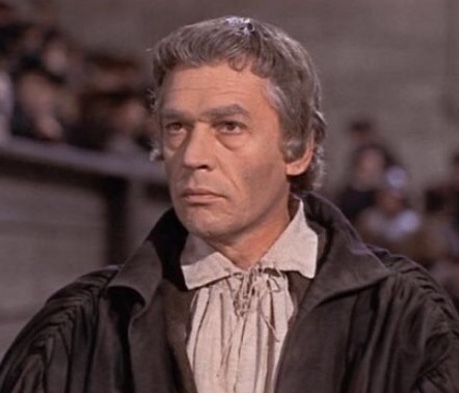
There’s no other contender to be honest, although George Chakiris, Peter O’Toole, Ron Moody, Oliver Reed and Dustin Hoffman were memorable contenders in a surprisingly male-heavy decade. The beauty of Schofield is his minimalism. In fact, he doesn’t need to do much. The man is naturally a brutalist statue- imposing, gravel-voiced, slow-moving, unshakeable, with just the right streak of vulnerability. His opening scene with Orson Welles as an insecure Wolesley suggests smugness, comfort but caution. His stillness and vocal authority during his interrogation scenes in which he refuses to conform to his King’s demands project an image of an immoveable boulder. And his final goodbye scene with his family sees him crumble like we all do when we have stayed strong for too long - with suddenness and a total lack of control. The performance is a work of art.


Doug says: Ron Moody in Oliver!

Unusually - for me - I was torn between a few different performances for this. You have Paul Schofield and Robert Shaw in A Man For All Seasons as Thomas More and Henry VIII respectively. You also have Dustin Hoffman in Midnight Cowboy as the rat-like Rizzo, not forgetting Alec Guinness in Lawrence of Arabia. All these were stellar performances, and a sign that male actors were breaking free of the dull upright roles and creating interesting, twisted characters. But for me Ron Moody’s tour de force as the thieving, dark-hearted Fagin wins this one. It’s a performance that reveals layer after layer, and despite being the heart of a cheery musical, Moody gives us darkness and a bleakness underneath the overt friendliness. A fantastic and note-worthy turn. 


Favourite Female Performance 


Paul says: Julie Andrews in The Sound of Music
You didn’t think I’d get through a whole 90 years’ worth of Oscars films and NOT give Julie a whole paragraph, did you?! It’s hard to turn saccharine into spontaneity but that’s just what Julie built her career on (and yes, I call her Julie like a know her. Sue me). She’s so endearing that you can’t help feeling a sharp streak of hatred for those Von Trapp children who get her as a stepmother. The Von Trapp’s moan about their home and country being invaded by an army of racist human rights abusers, but they should count their blessings that Captain Von Trapp didn’t employ Lady Tremaine as their new governess. Julie leaps and bounds through the film with an unparalleled, infectious energy- and after her marriage to the Captain she credibly transforms into a dignified but warm-hearted head of the household. No one else could have done it (not even me…..ok, maybe me).  


Doug says: Joan Shawlee in The Apartment

Whereas this was a great year for the men, it wasn’t quite so fantastic for the women. Although we have some star turns - Julie Andrews in The Sound of Music, Rita Moreno in West Side Story, the films felt more focused on the men, and the issues of the day - racism in In The Heat of the Night, poverty (and more) in Midnight Cowboy, and sex in general in Tom Jones. My runner up has to be the wonderful Wendy Hiller for her role as Thomas More’s wife Alice in A Man for All Seasons, but my winner, with about five minutes of screen-time, is Joan Shawlee in The Apartment. It's such a small role from an unknown actor that I couldn't even find a photo for this award! She plays the tiny role of a character’s mistress, but bounds through it with a mixture of joie-de-vivre and comic timing, to the extent that I keep recalling her performance over three months later. Best remembered for her line ‘either you get a bigger car or a smaller girl’, she reinforces the adage that there are no small parts, only small actors. Brava. 


Favourite Film 


Doug says: The Sound of Music
There’s only one. Oh you can throw all the artsy new-wave films (Midnight Cowboy), issue-packed pieces (In The Heat of the Night) and novel adaptations (Tom Jones) at me that you want, nothing quite beats a bunch of nuns, a stoic governess and a race to beat the Nazis. The Sound of Music has delivered all through childhood, and continues to deliver today. Whether it’s watching Maria teach the children about experiencing joy in everyday life, or watching the final tense scenes as they flee the Nazis, this masterpiece never shies away from darkness, while always reminding us that what matters in life is love, friendship and refusing to give up in the face of absolute evil. And if you have a bunch of nuns and a Mother Superior cheering you on tunefully, then so much the better. 


Paul says: Oliver!


Surprise! The gays both chose musicals! Didn’t see that one coming, eh? Actually, my biggest surprise was not choosing The Sound of Music. I commenced the '60s certain that I had pre-chosen my favourite film already. But after years of simply not owning the DVD, a re-viewing of Oliver! proved me wrong. I loved remembering the hints of terror and blatant abuse mixed in with jolly chorus numbers involving more extras than Ben-Hur. The big numbers, in fact, are so intricate that they need to be seen to be believed. Each group of extras are given some kind of Victorian occupation and a dance routine to match it (the butchers are dancing with legs of lamb, the window cleaners are dancing with ladders, blah blah) and each group’s choreography blends in with the others’ to create a party bigger than Glastonbury. But the film handles the little numbers- Nancy’s croaky-voiced “As Long As He Needs Me”, Oliver’s super-dubbed “Where is Love?” and Fagin’s hilariously nihilistic “Reviewing the Situation”. Every song is not only catchy but has it’s own unique sound. Fagin’s numbers have a Fiddler on the Roof quality (perhaps the closest the writers dared come to his character’s religion), Nancy’s numbers have come right out of a music hall, and the short “Boy for Sale” is pure opera. It’s a film with variety, panache, and power. And I want to see it again RIGHT NOW. 


Average Film Scores 

Paul: 6.8
Doug: 6.85

Sunday, 25 March 2018

42. Midnight Cowboy (1969)


Plot Intro

Young, handsome Texan Joe Buck (Jon Voight) travels to New York City to seek his fortune as a male prostitute. He befriends a street-smart layabout, Rizzo (Dustin Hoffman), and the two try attempt to make their way in the grimy, unpredictable metropolis.

Doug says...

Well it’s been a decade filled with a wide variety of films, from musicals (West Side Story, The Sound of Music, Oliver!) to soaring epics such as Lawrence of Arabia and A Man For All Seasons. All this makes the fact that the 1960s ends with Midnight Cowboy even more extraordinary.

Because this is a film of a new era. There’s male and female nudity, frequent blunt depictions of sex (both straight and gay) and overall the depiction of a grimy, unromantic New York that feels akin to more modern films like Se7en. Our hero Joe Buck is a fresh-faced handsome country boy who has set his heart on coming to New York - to make his fortune as a rent boy. My Fair Lady it ain’t. 

It’s also fascinating for the sheer depths we see him plumb to. He uncomfortably lets a man perform oral sex on him, he lives in a condemned building with his friend Rico (Dustin Hoffman delivering a performance where you can actually feel the dirt and grime on his skin and clothes), and his disillusionment & violent streak gets worse and worse. 

And it’s not just him who suffers. Everyone in the city is bizarre - from a woman who appears to be high on acid that ecstatically moves a toy mouse over her own face, to the revellers at a strange ‘art’ party who silently film each other and speak in monotones. But Joe Buck has a past, hinted at through black and white grainy memories, that speak of his girlfriend and himself being caught having sex and being attacked by gangs. It’s never made clear what happened, and the nightmarish quality of these memories mean you never believe quite what you’re seeing. 

The film’s techniques are fresh - and reminiscent of Citizen Kane in its unexpected modern take. Camera angles are used to their best effect, scenes are shot in black and white, colour, grainy textures, and director John Schlesinger manages to convey the dirt and grime of these situations. New York rarely seems so unglamorous and lonely, as when Joe hangs about outside cinemas, hoping that this time he’ll meet a rich woman ready to make him her lover. 


Ultimately, it’s not a film that has much of a plot, bearing real similarity to slow-burning character studies like Withnail & I. Boasting two excellent central performances, and subject matters that are refreshingly modern and open in comparison to the coy references of the early ‘60s and before, this is a film harkening a new hero. 

Highlight 
Dustin Hoffman bursts on to the screen as Ratso Rizzo, and delivers a compelling, provocative performance that ends up stealing the whole film. 

Lowlight
It feels a little long at times, considering there’s minimal plot, and I ended up with a strange emptiness, as if there’d been a message that hadn’t quite been delivered.  

Mark 
7/10 


Paul says...


It’s true, of all the decades we have seen the biggest changes in subject matter during the 1960s. We started with coy sex comedy, The Apartment and have ended with a film that literally has Jon Voight buttock-naked in the shower. 

This is an obvious reflection on the sweeping social change throughout the decade, but what Midnight Cowboy does very well is that, on its own, it creates a unique and memorable image of America. In New York City, Joe Buck comes across people ignoring, dismissing and mocking him. And the first woman that does eventually hire his physical services manages to convince him that she had no idea he was a gigolo. Rizzo himself is so permanently covered in grime and lives in the most abject squalor that he would fit in well with the sewer wildlife. He even moves like a rat with his bustling limp and twitchy eye. In this New York City, there are no endless opportunities- you’re either rich and uppity, or poor and resorting to petty crime to get by. Complete with the despondent harmonica-based score and the blink-and-you-miss-them peace protests in the background, this is, in short, the jaded Vietnam-era America as seen through the eyes of the pacifist Liberal. 

The surrealist aspect of the film is refreshing too. There are several fast-paced montages at times of intensity that combine several strands of thought. When Joe flees a bonkers pimp whom he was recommended to by Rizzo, he runs for the subway whilst at the same time recalling images of what I think is the kidnap and rape of his girlfriend in Texas (this is never fully explained), sees images of what he is actually doing, images of himself managing to track down Rizzo and strangle him in revenge, and images of himself failing to track down Rizzo. I’ve never been a fan of art-house-style film-making but segments like that display a character’s past, present, what they want to do and what they are worried about, without the use of lengthy exposition. We see similar montages throughout that provide some insight into Joe’s relationship with his Grandmother, who appears to have raised him.

“Some” insight, however, is the key phrase here. The film promised me some explanation for these frantic, ethereal internal thoughts and memories. It’s obvious that some are true and some are false because they conflict with each other, but I was looking forward to a revisitation to Joe’s past that would clarify why he has this desperate-to-please attitude to life and why he can’t or won’t amount to anything other than a sex worker. He could have explained some the clues about his character later on (he has a good listener in the form of Rizzo), or his later actions could have related back to these flashbacks. Neither occurs. And, as a result, I felt no real investment in his character. Dustin Hoffman’s Rizzo is more watchable because Hoffman transforms as magnificently as Ron Moody did into Fagin last week. But again, there is no insight into the character’s motivations or past to explain why he has ended up living like a mangy fox in South London, and done nothing much about it. Perhaps audiences at the time were so disenchanted with a Vietnam-battling government, that a street-rat such as he needed no further explanation.

This lack of character depth then has a knock-on effect when the ending, designed to be tragic, came across to me as a little contrived and emotionless. The character I was most moved and fascinated by was America and in particular late-60s New York City itself. That at least kept the film atmospheric, tragic, often daft, and visually gripping enough for me to never be bored. 

Highlight
Hoffman’s performance is, indeed, the stuff of legend. My favourite moment was when he sends Voight into a women-only hotel to pick up clients. As Rizzo waits outside, he dreams of glamorous Florida hotels where he lives his life partying with pretty women under a languorous sun. When Voight is suddenly thrown out of the hotel, the women in the day dream turn on Hoffman, and throw him into the pool. It’s fun, but a sad slice of internal monologue.

Lowlight
I would have liked the film to connect up more with the establishing flashbacks to create a “full circle” structure. What do Joe’s Grandmother and ex-girlfriend have to do with where he is now? We can only guess, and that’s not satisfying enough for me.

Mark
5/10