Showing posts with label Robert Redford. Show all posts

Monday, 17 September 2018

58. Out of Africa (1985)


Plot Intro

Danish woman, Karen Dinesen (Meryl Streep), moves to Kenya with her new husband, Bror von Blixen (Klaus Maria Brandauer), where they intend to establish a dairy farm. However, Bror is more interested in sleeping with the servant girls and big game hunting, so is away a lot, and Karen must run the farm on her own, and conduct an affair with handsome game hunter, Denys Finch Hatton (Robert Redford).

Doug says...

This was the perfect film for a Sunday evening. I think I actually dozed off about three times and still grasped entirely what was happening. It’s a soft drama, aiming to be an African-based version of the BBC hit series Lark Rise to Candleford in which literally almost nothing happened and there were lots of soft-focus shots of sunsets.

Unfortunately, a film approaching three hours demands a little more plot, and we’re not really given that here. It doesn’t help matters that only a couple of years ago we had the extraordinary Gandhi which managed to capture a real sense of a very-far away land. Here Africa is one of the main subjects - it is the catalyst for everything happening and everyone coming together - and yet it never feels more real than a painted backdrop. They’ve clearly hired actual African villagers to be in the film, and yet never use them above fleeting glimpses as if to ground the action before swivelling back to the rather beige romance between Karen and Denys.

The fact is that Karen and Denys’ affair in real life was actually just a fragment of a far more interesting background. There was a hedonistic and elitist group of largely British aristocrats in Africa at the time, including Beryl Markham, the first woman aviator to fly solo, non-stop across the Atlantic from east to west. Markham actually moved in with Karen, set her sights on Denys and began an affair with him - Denys actually ended up having affairs with both women simultaneously, under the same roof. A tad more scandalous than the tame matter we’re offered here.

It’s not great stuff, and there’s real missed chances - both with the plot (Markham doesn’t even appear, but is ‘represented’ briefly by a character called Felicity), and with the setting - Africa doesn’t feel integral in any way, beyond a pretty backdrop. What I found most interesting is Meryl.

Meryl Streep has long been regarded as one of our greatest film actresses. But the appearances I’m seeing from the ‘80s, and the stuff I’ve seen from the ‘90s doesn’t lift her much above her peers. While she has some flashes of great acting here, it’s all a bit too held back to affect us. In films like Kramer vs Kramer she was heavily out-shadowed, and looking ahead she has the great campy classics like Death Becomes Her - but nothing that makes her shine.

In fact a quick Wikipedia shows that while she made her name with these soapy melodramas in the ‘80s, she lost top billing fairly quickly in the ‘90s and it was actually her role in a certain fashion-based film that sent her soaring back into the echelons of highest Hollywood. That’s right - her career was flagging pre-Devil Wears Prada. I, for one, had always assumed she’d just always been up there, but what actually transpires is we are currently in the golden age of Streep’s acting. She’s never actually been better than Prada, The Hours, August:Osage County, Doubt - and my own favourite Florence Foster Jenkins. It’s actually quite cheering to see that an actress who really got going in the ‘80s actually hits her real stride in the early noughties.


The film? Eh, it verges on instantly forgettable. It seems odd that it beat the seminal The Color Purple, but at least it didn’t win any acting trophies. It’s not hateful, it’s just not…anything. 


Highlight 
Those few moments when Meryl delivers a line a certain way or shoots someone a look and suddenly you see a glimpse at the great actress that’s a few decades away in the making. 

Lowlight
Why would you shoot everything actually in Africa and then somehow make it all seem two-dimensional and dull? How?! 

Mark 
5/10


Paul says...


As Doug says, this is ideal Sunday evening entertainment. It would be completely at home at 9pm on ITV, and have the word “heart” somewhere in the title. But instead, this is the 1985 Best Picture winner, so expectations are, understandably, a little higher.

The biggest and, for me, only strength of Out of Africa, is its beauty. Director Sidney Pollack does for Kenya what Richard Attenborough did for India and David Lean did for the Arabian desert in previous films we have blogged about. He establishes a setting that is a character in itself- visually stunning and perfect for Instagram, but also terrifying due to its natural power over mankind. Scenes in which Meryl Streep finds herself face-to-face with lions, and Karen and Denys’ lengthy flight over the Kenyan countryside, remind us of this remarkable superiority that the natural world has over humans.

But whilst the film is Beautiful (and yes, the capital B is intentional) in that it ticks all the boxes to be considered for a place in the Louvre or to have gap year students waxing lyrical about their own experiences in this part of the world, Out of Africa is pretty lacklustre. Which is a massive shame because Karen Blixen led a pretty interesting life. The film shows her gradual loss of the farm and money troubles; her affair with Denys; her contraction of syphilis from her husband’s own affairs; she painstakingly brings resources to her husband’s regiment during the First World War; she sets up a school and contributes more advanced medical care to the Kenyan people. But the script and direction tackles all of this with such an objective, mannered and understated eye that nothing lifts above murmur. A film such as this needs to shout louder and have more to say.

Karen herself could have been presented as much stronger and feistier to put the audience behind her and Denys especially gets nothing to do except look handsome and be American. The real Denys Finch Hatton was an English aristocrat, so it seems very calculated that Redford should retain his American accent and act more like Indiana Jones, but with no sense of humour, because it would make the film appeal to the less esoteric members of the audience who may favour Mills and Boon romances over historical drama. This tale of an aristocratic woman falling in love with a the grizzled local hero is not what happened, nor is it told with a shred of fun or emotion. If you want that sort of story, I would recommend seeing Katharine Hepburn in The African Queen, Kathleen Turner in Romancing the Stone, or Rachel Weisz in The Mummy, all far more exciting and more deserving of notoriety than this.

Out of Africa’s mediocrity is further shown through the fact that it covers about 20 years of history, but at no point is this scale of time felt. I only found out by reading up on the real Karen Blixen, and this was at a point where I thought the film had covered less than half that time. None of the characters aged, nor did their fashion or hair styles change with the times. Gone With the Wind, Lawrence of Arabia and Gandhi are similarly ambitious and episodic epics, but their sense of scale leaves you physically and mentally exhausted by the end, much like the characters you’re watching. By the end of Out of Africa, I felt nothing. I don’t think the film even climaxed at any point.


To reiterate Doug, Out of Africa is not terrible mostly because it’s lovely to look at. But like Instagram models, this is not enough. There’s a deadness behind the eyes that makes it fit well within a decade that is quickly turning out to be trite. 

Highlight
Karen and Denys’ plane flight is actually quite a lovely sequence. It’s captures the beauty of the African landscape and it’s a shame the rest of the film couldn’t match this sense of awe.

Lowlight
A lengthy dialogue scene between Karen and Denys on a beach in which they discuss the future of their relationship is a prime example of why the film fails. Much of it is just words, words, words, and left me with a distinct feeling of “so what?”

Mark
2/10

Sunday, 5 August 2018

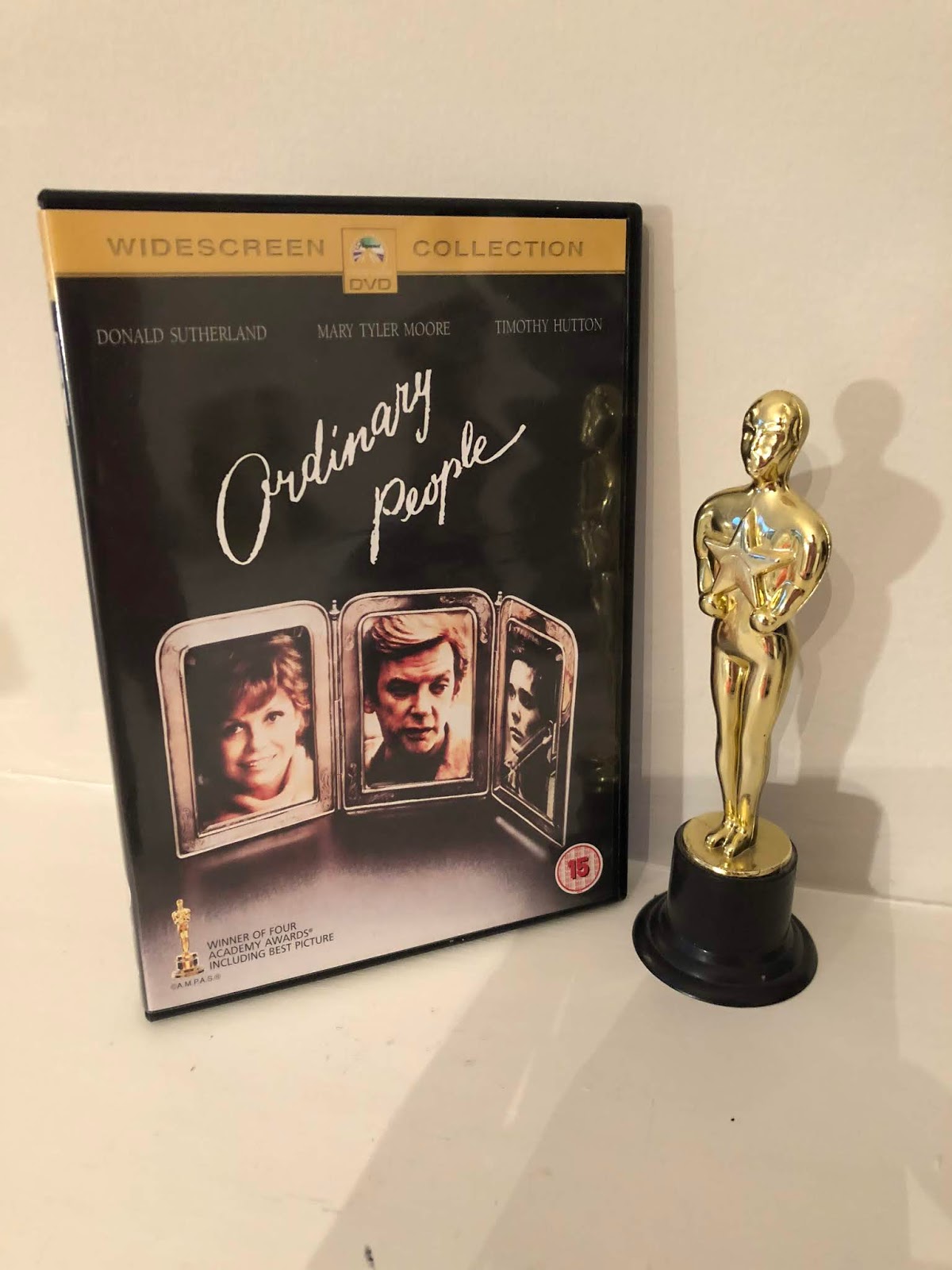
53. Ordinary People (1980)


Plot Intro

The Jarrett family are an upper-middle class family living in Chicago, consisting of parents Calvin (Donald Sutherland) and Beth (Mary Tyler Moore) and their son, Conrad (Timothy Hutton). But what becomes abundantly clear is that they are grieving the loss of their elder son, Buck, who died in a boating accident that Conrad survived. Torn apart by guilt from not saving his elder brother, Conrad’s mental health has spiralled out of control, he has tried to kill himself, ended up spending some time away in a mental health institution, and now consults a therapist (Judd Hirsch). And his parents aren’t dealing too well with it all either…

Doug says...

One of the strangest things about this project is how neatly the decades encompass radically different styles and themes within the winning films. In the ‘50s it was all glamour and witty phrases, in the ‘60s it was bright bubbly musicals and in the ‘70s it was dark, gritty analyses of masculinity. 

Here, opening our study of the 1980s, is an extraordinarily different beast. Ordinary People is much like How Green Is My Valley in that I’ve never heard of it in any circumstance. It is also like How Green Is My Valley in that it is exceptional. 

The film explores a wealthy family after the eldest son dies in a boating accident. While it focuses mainly on the younger son Conrad - who is severely traumatised - it also deals with the mother and father played by Mary Tyler Moore and Donald Sutherland respectively. Conrad receives next to no sympathy from his mother who is cold through and through, and while his father is desperately trying to help him, he is suffering. Enter the therapist - and while it’s now a little obvious to have the therapist be a very human, ordinary person, I can’t help feeling this film was setting a precedent. 

The obvious comparison is Good Will Hunting where Robin Williams made it clear just how brilliant an actor he was - but here the therapy is a strand of the story not the whole thing. It verges at times on being too sentimental, but there is a scene towards the end where Conrad finally starts talking truth, and it’s electrifying. Everyone here is pulling their weight, and it’s bizarre that it was Robert Redford’s directorial debut because the shooting and precise piecing together of this feels the work of a far more experienced director. 

I’m also delighted to say that contrary to last decade, we already have two contenders for Best Actress for the 1980s straight out of the gate. In her film debut Elizabeth McGovern (better known now as Lady Cora of Downton Abbey) is remarkably assured and also looks weirdly like Stockard Channing. But the film’s real talent is Mary Tyler Moore who moves beyond any performance I’ve seen her give previously, and captures the mother who is unable to express sentiment despite occasionally desperately trying to. There’s a scene where she comes out to sit by her son in the garden and you just feel her trying to work out how to connect with him - and then her ultimate inability to is depressingly real. Also - the fact she never says that she wishes Conrad had died instead of her other (favourite) son, and yet it’s all you can think about when she’s on-screen is testament to the performance she gives. 

It’s also a film that doesn’t play to the obvious. When the therapist tells Conrad he has to forgive a certain person in his life, we assume (along with Conrad) that it is obviously Conrad himself (I mean, obvious right?). Wrong. And when we find out who the therapist is actually talking about, it’s both surprising and very accurate. If this was a film made now, there would be a moment when the mother finally breaks down and everyone starts to heal. Here, they take a more realistic path that is more upsetting but also more valuable for its truthful angle.

What’s bad about it? Not much, but there are a few too many hammy moments, and I’m wondering (from what I know of the ‘80s) whether this may be a constant issue. This film felt refreshingly modern most of the time (I drew a lot of comparisons with 2018 Oscar nominee Lady Bird) and so the moments that it proved its age were jarring. 


As an opening to this new decade? Cracking. It was powerful, made its points well, addressed things like suicide and social pressures with ease and real truthfulness, and I didn’t want to check Instagram or stare out of the window once

Highlight 
Mary Tyler Moore proving her acting chops was an unexpected delight. It’s a brilliant, savage performance and better than anything the ‘70s provided. 

Lowlight
A few too many hammy moments (people sighing too dramatically or overacting in the background) kept this from being flawless. 

Mark 
9/10 


Paul says...


I thought the more obscure Best Picture winners were far behind us, but here comes another one just 9 years before I was born. Despite its high regard, Ordinary People is not an '80s movie that gets discussed much, unlike other Best Picture winners from around this time such as Chariots of Fire, Out of Africa and Platoon. Perhaps it has become overshadowed by its fellow nominees such as The Elephant Man and Raging Bull, both stiff competition and are much more publicly known amongst younger generations. 

But whatever the reason, it’s an unfair one, because Ordinary People is a lovely, emotional movie. It displays a transition period between the '70s and '80s, because it is both an intense psychological study of a family falling apart due to grief, but we’re seeing much bigger expressions and occasional movements into melodrama that are much more reflective of the 80s ethos (we are, of course, in the Dallas/Dynasty era now). 

It’s odd that Timothy Hutton was nominated for and won Best Supporting Actor rather than Best Actor (fun fact: he is still the youngest ever recipient of this award, at just 20 years old). The film is far more focussed on Conrad than on his parents, but I suppose Sutherland and Moore had more cultivated careers, hence their top billing. Hutton is outstanding, perfectly displaying the extreme forms of grief. I was totally convinced that we were watching someone so riddled with guilt, trauma and helplessness, that he feels he has no option but to take his own life. He swings wildly between putting on a brave face, and having a panic attack, and this is helped by Redford’s controlled direction, in which we discover this character’s past through rapidly-cut flashbacks and literally seconds of memory. It’s a deserved win for Hutton, but really his volume of screen time should have got him more than Supporting Actor.

I also loved the character of his therapist, Dr Berger, played superbly by Judd Hirsch, who was also nominated for Best Supporting, and 90s kids may recognise him as Jeff Goldblum’s panicky father from Independence Day. The beauty of the scenes between him and Hutton are that they steer clear of the sentimental. Berger is a confrontational, hard-hitting therapist, who isn’t afraid to ask uncomfortable questions, challenge his patients and force them to face up to their own faults as well as those of people around them. I feel like we all need a Dr Berger in our lives, whether you’ve just watched your elder brother drown or not. 

I’m also tremendously excited that Mary Tyler Moore has made her way into this project. For me, she can do no wrong, neither as a ditzy 60s housewife in The Dick Van Dyke Show, or as a plucky single career woman in her own groundbreaking '70s sitcom, the aptly-named Mary Tyler Moore Show. Here, she plays totally against her Bridget Jones-esque type, as the sort of upper-middle class house-proud wife who desperately wants to maintain her image of control, affluence and serenity. She sees pitying Conrad as “indulging”, and is furious when her husband tells a friend that Conrad is seeing a psychiatrist. To her, mourning and bad mental health is shameful. The film’s biggest failing for me was the way in which the script lets her down. Hutton gets so much time with Dr Berger that we see the full spectrum of his character, and Donald Sutherland gets a huge amount to work with too. Moore, even by the end of the film, remains a cold, emotionally-stunted wife, and has no breakthrough moment. I see that the film was meant to do this, to show that sometimes people don’t change regardless of the consequences of their actions. But I wanted to know more about her- why is she like this? What are her memories of the family’s past events? What is her background here? It’s a testament to Moore that she conveys so much, when the script gives her character so little compared to her husband and son. It was totally dissatisfying to see their characters so well-rounded and hers being so simple. Nonetheless, she got a Best Actress nomination that is well deserved- she lost to Sissy Spacek.


Ordinary People, as Doug says, is a great way to start off the '80s. It’s a touching dissection of a family under great emotional strain and teaches audiences that sometimes, the best way to deal with grief is to discuss it rather than avoid it. It’s a less-known winner, but a strong one.

Highlight
Any of the scenes involving Judd Hirsch as Dr Berger. I almost wanted the film to be entirely set in his office, with every character getting a moment with him. This would at least have fleshed out Mary Tyler Moore’s character more satisfyingly.

Lowlight
The film steers dangerously close to '80s-style platitudes. A prime example is when Conrad is on a date (with Cora from Downton Abbey, no less!). She asks him what it’s like to try to commit suicide, and he embarks on a speech about it feeling like a “deep dark hole” or something like that. I find it hard to believe that someone as downtrodden as he could so eloquently use this imagery to describe suicide. But I feel this is something that becomes fashionable during the overstated '80s.

Mark
8/10

Saturday, 12 May 2018

46. The Sting (1973)


Plot Intro

Chicago, 1936. Two grifters named Johnny Hooker (Robert Redford) and Luther Coleman (Robert Earl Jones - father of the voice of Darth Vader, James Earl Jones) play an old con trick on a seemingly innocent bystander and steal his money. Unfortunately, this bystander turns out to be an employee of a notoriously ruthless crime boss, Doyle Lonnegan (Robert Shaw). Lonnegan is furious about this humiliation and has Coleman murdered and sends men after Hooker too. Hooker escapes and gets in contact with another friend of Coleman, Henry Gondorff (Paul Newman). Together, Hooker and Gondorff develop an elaborate plot to bankrupt and gain vengeance on Lonnegan.

Doug says...

The Sting is both fitting and an odd addition to the ‘70s films we’ve seen so far. It has the same grittiness and real-life elements - we see men in vests, unmarried sex and tatty rundown burlesque clubs - but what it brings to the table is a welcome slice of lightness and fun. It’s not a comedy by any means and there’s no laugh out loud moments, but nor are there millions of tortured close-ups of drug-addled gangsters’ faces. It’s refreshing. 

It does suffer slightly from a modern point of view. And this is for one simple reason - Hustle. The BBC show starring Adrian Lester and a whole host of cracking actors, featured a bunch of Robin Hood-esque con artists wreaking havoc on London, and over the course of several seasons shows the inner workings of most cons. And the twists-and-turns style of The Sting is marred by the fact that a modern viewer who has seen Hustle will actually be ahead of the game. I saw the ending coming and so what would have thoroughly surprised 1973’s cinema audience actually came as no great shock to me. 

Having said that it’s still a pleasure to watch. Paul Newman is oh so handsome and charismatic to boot and he leads a strong cast including Robert Redford as the wronged con-artist seeking revenge, Eileen Brennan as Billie, the tough no-nonsense owner of the local bar/brothel and a tiny but fun cameo from Sally Kirkland as Crystal - a fame-seeking burlesque dancer. It’s a fairly well paced film with lots of examples of cons, and jaunty piano music throughout which negates some of the nastier moments (we do see quite a few people shot in the film). 


It’s not a masterpiece, but it is great fun, and such a welcome relief from the stodgy dark films of recent times. I’ve actually had a bit of a revelation about why I don’t really like the ‘70s so far. It’s not that they’re dark films - my favourite film is La Vie En Rose, an almost unrelentingly bleak biopic of Edith Piaf - but it’s the turgic, stolid tone that they seem to take. They are bound up in their own darkness, and it all feels a bit too try-hard art-house to me. But I imagine this is because they were actually breaking new ground, and ground-breaking pieces tend to be a bit overdone because they have no precedents to guide them. I should be a bit more forgiving on the 1970s films, but working from a place where we have built upon them, I find them often a tad insufferable in their abject misery. But The Sting was a pleasant change - mixing lightness and slick choreography into the mix. 

Highlight 
The moment when Billie carries a tray of drinks into the con-artists’ private den, having just warded police off from bursting in there. She moves at a normal pace, yet you can feel the tension underlying the scene as she needs to get in there and warn them. Great, understated moments that do so much for the viewer. 

Lowlight
The film is made of fairly short scenes and yet feels a little longer than its two hour running time. I wonder if it would have benefited from a cut to 90 minutes…

Mark 
7/10 


Paul says...


We continue through our crime spree (so to speak) but, as Doug says, with a greater sense of fun. If you like the 2001 remake of Ocean’s Eleven in which George Clooney and Brad Pitt gain vengeance on a nefarious casino owner by robbing his vaults, then you’ll enjoy this earlier tale of two buddies doing similarly criminal shenanigans to bring down a Bad Man. In fact, it’s so similar that Paul Newman could pass for George Clooney’s father and now I’m completely certain that Brad Pitt had facial surgery to look exactly like Robert Redford. The resemblances between the two generations of actors is uncanny.

The Sting benefits from tremendous charisma from the two leading men, and if you’ve never heard of them you can just Google search “Actors your mum is in love with” and they’ll pop right up. Newman and Redford had worked together before along with director George Roy Hill in Butch Cassidy and the Sundance Kid. They were good friends, played pranks on each other behind camera, and as a result a natural chemistry shines through. 

I also really enjoyed the villain of the piece, Doyle Lonnegan played by Robert Shaw who we last saw in this project as the mercurial Henry VIII in A Man for All Seasons. His character is more mannered here, but what I enjoyed was that he’s not a super-humanly capable villain who is seemingly impossible to defeat. He repeatedly becomes a victim of his hot temper and lust for money. In other words, he’s a typically immoral businessman but with so many skeletons in his closet that it’s a delight to see Newman and Redford bring him down. The scenes in the fake betting parlour are especially tense and amusing. Lonnegan is under the impression that he is betting on winning horses. In actual fact, the races have already happened, and every single person from the bartender to the radio announcer to the other gamblers, are actors in league with our heroes. The big kick the audience gets from The Sting is being in on the act with our handsome heroes, and seeing a complete arsehole be made to look like a fool. No matter how much of a good person you are, any audience member enjoys seeing someone become victim of an intelligent con- as long as the con artist is attractive and charismatic of course.

The intricate story-telling also kept me hooked. There are cons within cons, unexpected betrayals and reveals to discover that someone is not who they claim, or not in league with who we thought. A couple of times, after spending two minutes looking up IMDB facts about the film, I found that when I returned my attention to the film, I had missed an important plot point very easily. The film is fast-paced and complex, so if you do give it a go I’d advise concentrating for the full two hours to keep up.


I can’t fault this film too majorly. A niggling point is that I didn’t have a huge amount of emotional investment. The Sting may be thrilling and I enjoyed working out how the characters were going to double-cross each other, but I didn’t care much if the heroes succeeded or not. Any wins they gain throughout the story garnered more of a “oh I see” reaction from me rather than ecstatic cheers. This is a minor failing though - overall, The Sting is addictive and exciting and a breath of fresh air in a movie era fraught with darkly-lit depravity and despondence (indeed, another nominee this year for Best Picture was The Exorcist and you don’t get much darker than that).

Highlight
Gondorff’s Poker game with Lonnegan and his associates is a great set of scenes. Newman is evidently having the time of his life pretending to be drunk and putting the arrogant crime boss down at every opportunity. 

Lowlight
Perhaps we needed more urgency in the good guys’ motivations towards bringing down the villain. Lonnegan could have been given more villainous actions to make us hate him more to gain more emotional interest.

Mark
9/10