Sunday, 12 August 2018

54. Chariots of Fire (1981)


Plot Intro
It’s 1924. Aspiring sprinter, Harold Abrahams (Ben Cross) pursues his ambitions to win Olympic Gold whilst at Cambridge. He is held back a little, however, by his Jewish heritage and his employment of a coach, Sam Mussabini (Ian Holm), not something usually done at the time. Another aspiring Olympian, Eric Liddell (Ian Charleson), also works as a Christian missionary in China, and believes that his running is a demonstration of his faith in God. The two runners, and the rest of their team, head to the 1924 Olympic Games in Paris…

Paul says...

My feelings about Chariots of Fire are similar to those towards Annie Hall. Whilst Annie Hall was not a bad film in the slightest, I found myself pining to be watching its rival for Best Picture in 1977, Star Wars. Chariots, meanwhile, is not terrible, but it defeated an equally bombastic blockbuster, Raiders of the Lost Ark, and if the Academy had voted a different way, we could have been watching Indiana Jones instead.

Chariots is somewhat reduced from a historical and inspirational film about sports to a piece of extremely famous music and much slow motion running on the beach. There is, of course, more to it than that, but Chariots received only one acting nomination - Supporting Actor for Ian Holm. The leading two actors will appear obscure to most viewers, unless you’re a real film buff. And I challenge anyone in our generation to name one other famous scene than the opening race on the beach. In other words, it’s generally a bit forgettable despite its stylistic aspirations.

I kept comparing Chariots to our other most recent sport-themed movie, Rocky. The boxing classic has serious drive. You really feel that this fight is Rocky’s one last chance at proving that he is worth something in this world- he may be a handsome, golden-hearted, droll giant, but he’s impoverished, under-educated and doesn’t seem to have much else to fall back on. My fundamental problem with Chariots is that it doesn’t have this drive. These heroes are extremely privileged individuals- privately educated, wealthy backgrounds, plenty of other talents to back them up if their dreams of athletic stardom are squashed. Why should I be backing people with such first world problems?

It doesn’t help that only one of them has any real issue holding him back- Harold receives some minor jibes and comments on account that he is Jewish. But none of these seem to stop him. His talents are still recognised, he has plenty of support, and he can evidently afford a Cambridge education and a personal coach anyway. The most extreme form of racism he comes across is when his Cambridge master, played by John Gielgud, bemoans his coach’s Arab heritage (Mussabini was of Syrian, Turkish, Italian and French ancestry), but Harold recovers pretty easily with a well-rehearsed speech and then heads off to the Olympics anyway. I didn’t take much to Ben Cross who played this role either- I found him stiff, and lacking spontaneity.

Big saving graces, however, are enthusiastic performances from a very young Nigel Havers as a fellow athlete, Lord Lindsay, and Ian Holm as Mussabini. Both are evidently having much more fun. There’s an amusing moment when Lindsay practises for the hurdles by placing glasses of expensive champagne on each one and challenges himself not to spill a drop. And Holm felt very real as Harold’s stern, grouchy and warm-hearted coach. 

The slow motion running also provided lovely touches. The runners in these sequences end up being depicted as ethereal, superhuman beings, and it emphasises sports’ display of seemingly impossible feats of physicality. 


But all in all, I found Chariots of Fire to be a bit of an uninvolving piece. It’s a mildly interesting bit of history, and it probably won due to the 80s audience’s love of glamour, glorious costumes and speeches and set pieces that steer dangerously close to trite. Nonetheless, there are sports men and women who have overcome far greater adversities than these blokes. Jesse Owens, for starters.

Highlight
There is an early scene in which Harold and Lord Lindsay first prove their sprinting prowess by attempting to do the Great Court Run. Competitors have to complete a circuit of the court at Trinity College, Cambridge in less time than it takes the clock to strike 12 (approximately 43.6 seconds according to Wikipedia). Whilst Abrahams never actually ran the contest, it’s a stirring and very well-shot little scene.

Lowlight
There’s a great deal of time spent on Liddell’s dilemma when his race is put on a Sunday, and he forbids himself to run it due to his devour Christianity. For most of this plot line, I was thinking “so what? It’s his choice”. And the solution that comes is so simple and anticlimactic that I wonder what warranted the writers to put it in at all.

Mark
4/10


Doug says...

I find myself struggling to write more than a handful of words about this film - it’s well-made and far from atrocious as a piece of work. But on the other hand it’s not massively engaging and as Paul points out, the fact that they’re all privileged Cambridge students, some with titles, means you don’t particularly find any of them to be struggling in the way that cinema like this demands. 

Much like visits to the circus, I found it to be fading from the mind almost immediately after finishing and I attribute this really to a lack of interest in any of the characters. The plot is thin (they want to go to the Olympics - they go to the Olympics - film ends) and I found the heavy emphasis on religion to be a bit of a turn off. 

The heavily Christian Liddell is annoyingly pious and his decision not to run on a Sunday actually feels a bit thick. The Prince of Wales (played by the ever charming David Yelland) makes the pretty solid point that in religion, difficult choices are often put in front of you with no right answer, but Eric Liddell sticks his chin out and refuses to budge. He’s the sort of dullard you’d actively circulate away from at house parties. 

And while they try to make a point out of Harold Abraham’s Judaism and the reaction it garners (Sir John Gielgud saying some pretty horrendous things), I found the actor Ben Cross to have very little going on. It’s a mercy he’s pretty because he’s not giving us much else. Gentlemen’s Agreement back in 1947 played with anti-semitism far more effectively. 

And that’s really all I have to say on the film. So instead I’m going to talk about Ian Charleson who played Eric Liddell, and who I’ve read up on. He was a renowned stage actor, and in 1989 Daniel Day-Lewis walked out of playing Hamlet at the National Theatre and Charleson stepped in. His subsequent performance is still renowned and appears on several ‘Best Hamlets Ever’ lists across theatre criticism. 

He died eight weeks after closing Hamlet at the age of 40 from AIDS. He requested that his illness be publicised after his death so as to raise awareness of the disease. He was the first celebrity in the UK to publicly die from AIDS and there is a Day Centre at the Royal Free Hospital in his name.

In 1991 Liddell’s friends founded the Ian Charleson Awards, rewarding the best classical stage performances in Britain by actors aged under 30. The awards are now in their 27th year and the judges include renowned actors, critics, and people of significance across every area of the theatre business. 


All in all, a pretty cool guy. 

Highlight
The opening sequence with that music and the iconic running shots are easily the best thing in the whole film.

Lowlight
 I personally found it far from engaging and quite undeveloped, despite it being well made and clearly scripted. 

Mark
6/10 

Sunday, 5 August 2018

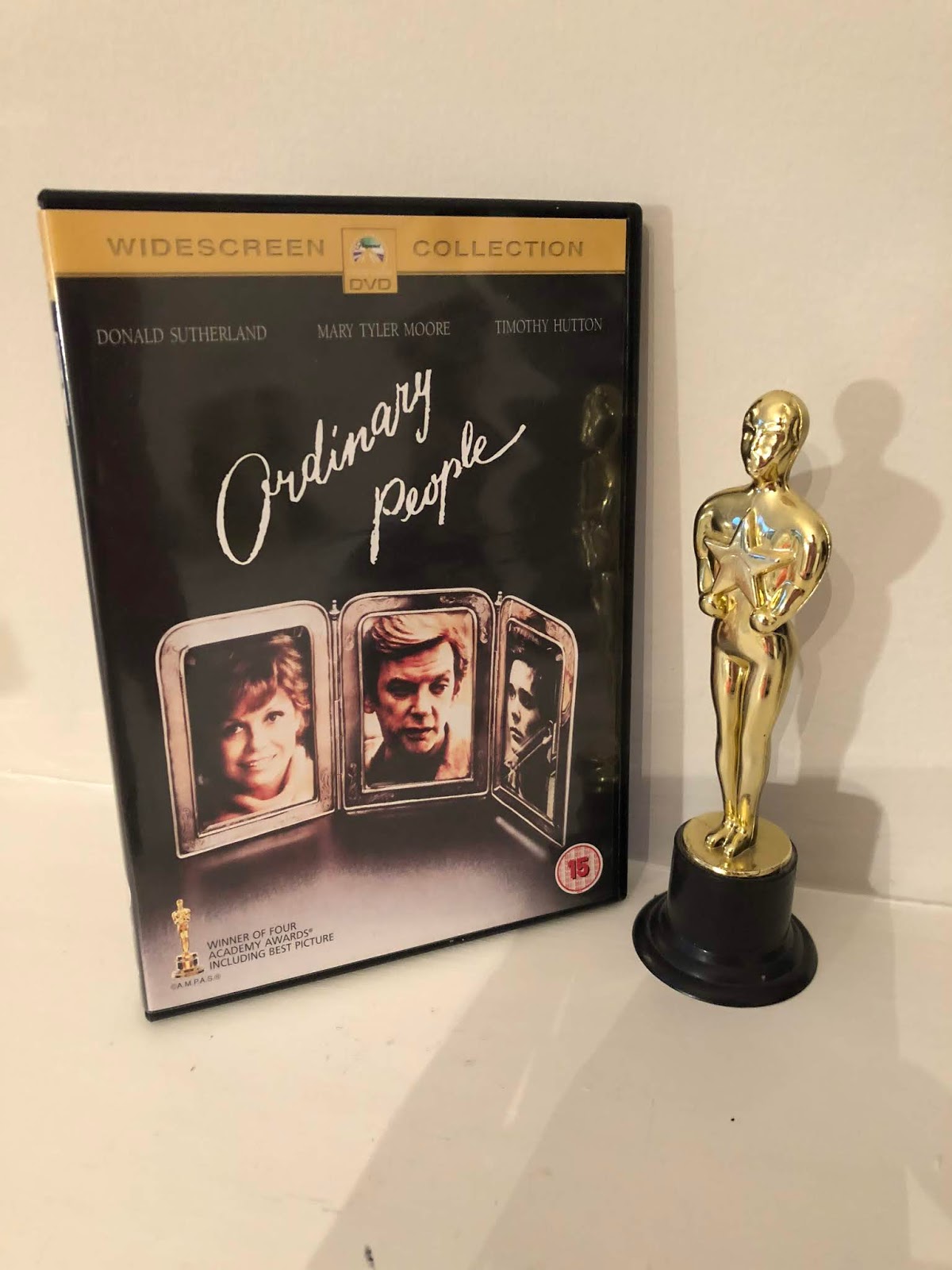
53. Ordinary People (1980)


Plot Intro

The Jarrett family are an upper-middle class family living in Chicago, consisting of parents Calvin (Donald Sutherland) and Beth (Mary Tyler Moore) and their son, Conrad (Timothy Hutton). But what becomes abundantly clear is that they are grieving the loss of their elder son, Buck, who died in a boating accident that Conrad survived. Torn apart by guilt from not saving his elder brother, Conrad’s mental health has spiralled out of control, he has tried to kill himself, ended up spending some time away in a mental health institution, and now consults a therapist (Judd Hirsch). And his parents aren’t dealing too well with it all either…

Doug says...

One of the strangest things about this project is how neatly the decades encompass radically different styles and themes within the winning films. In the ‘50s it was all glamour and witty phrases, in the ‘60s it was bright bubbly musicals and in the ‘70s it was dark, gritty analyses of masculinity. 

Here, opening our study of the 1980s, is an extraordinarily different beast. Ordinary People is much like How Green Is My Valley in that I’ve never heard of it in any circumstance. It is also like How Green Is My Valley in that it is exceptional. 

The film explores a wealthy family after the eldest son dies in a boating accident. While it focuses mainly on the younger son Conrad - who is severely traumatised - it also deals with the mother and father played by Mary Tyler Moore and Donald Sutherland respectively. Conrad receives next to no sympathy from his mother who is cold through and through, and while his father is desperately trying to help him, he is suffering. Enter the therapist - and while it’s now a little obvious to have the therapist be a very human, ordinary person, I can’t help feeling this film was setting a precedent. 

The obvious comparison is Good Will Hunting where Robin Williams made it clear just how brilliant an actor he was - but here the therapy is a strand of the story not the whole thing. It verges at times on being too sentimental, but there is a scene towards the end where Conrad finally starts talking truth, and it’s electrifying. Everyone here is pulling their weight, and it’s bizarre that it was Robert Redford’s directorial debut because the shooting and precise piecing together of this feels the work of a far more experienced director. 

I’m also delighted to say that contrary to last decade, we already have two contenders for Best Actress for the 1980s straight out of the gate. In her film debut Elizabeth McGovern (better known now as Lady Cora of Downton Abbey) is remarkably assured and also looks weirdly like Stockard Channing. But the film’s real talent is Mary Tyler Moore who moves beyond any performance I’ve seen her give previously, and captures the mother who is unable to express sentiment despite occasionally desperately trying to. There’s a scene where she comes out to sit by her son in the garden and you just feel her trying to work out how to connect with him - and then her ultimate inability to is depressingly real. Also - the fact she never says that she wishes Conrad had died instead of her other (favourite) son, and yet it’s all you can think about when she’s on-screen is testament to the performance she gives. 

It’s also a film that doesn’t play to the obvious. When the therapist tells Conrad he has to forgive a certain person in his life, we assume (along with Conrad) that it is obviously Conrad himself (I mean, obvious right?). Wrong. And when we find out who the therapist is actually talking about, it’s both surprising and very accurate. If this was a film made now, there would be a moment when the mother finally breaks down and everyone starts to heal. Here, they take a more realistic path that is more upsetting but also more valuable for its truthful angle.

What’s bad about it? Not much, but there are a few too many hammy moments, and I’m wondering (from what I know of the ‘80s) whether this may be a constant issue. This film felt refreshingly modern most of the time (I drew a lot of comparisons with 2018 Oscar nominee Lady Bird) and so the moments that it proved its age were jarring. 


As an opening to this new decade? Cracking. It was powerful, made its points well, addressed things like suicide and social pressures with ease and real truthfulness, and I didn’t want to check Instagram or stare out of the window once

Highlight 
Mary Tyler Moore proving her acting chops was an unexpected delight. It’s a brilliant, savage performance and better than anything the ‘70s provided. 

Lowlight
A few too many hammy moments (people sighing too dramatically or overacting in the background) kept this from being flawless. 

Mark 
9/10 


Paul says...


I thought the more obscure Best Picture winners were far behind us, but here comes another one just 9 years before I was born. Despite its high regard, Ordinary People is not an '80s movie that gets discussed much, unlike other Best Picture winners from around this time such as Chariots of Fire, Out of Africa and Platoon. Perhaps it has become overshadowed by its fellow nominees such as The Elephant Man and Raging Bull, both stiff competition and are much more publicly known amongst younger generations. 

But whatever the reason, it’s an unfair one, because Ordinary People is a lovely, emotional movie. It displays a transition period between the '70s and '80s, because it is both an intense psychological study of a family falling apart due to grief, but we’re seeing much bigger expressions and occasional movements into melodrama that are much more reflective of the 80s ethos (we are, of course, in the Dallas/Dynasty era now). 

It’s odd that Timothy Hutton was nominated for and won Best Supporting Actor rather than Best Actor (fun fact: he is still the youngest ever recipient of this award, at just 20 years old). The film is far more focussed on Conrad than on his parents, but I suppose Sutherland and Moore had more cultivated careers, hence their top billing. Hutton is outstanding, perfectly displaying the extreme forms of grief. I was totally convinced that we were watching someone so riddled with guilt, trauma and helplessness, that he feels he has no option but to take his own life. He swings wildly between putting on a brave face, and having a panic attack, and this is helped by Redford’s controlled direction, in which we discover this character’s past through rapidly-cut flashbacks and literally seconds of memory. It’s a deserved win for Hutton, but really his volume of screen time should have got him more than Supporting Actor.

I also loved the character of his therapist, Dr Berger, played superbly by Judd Hirsch, who was also nominated for Best Supporting, and 90s kids may recognise him as Jeff Goldblum’s panicky father from Independence Day. The beauty of the scenes between him and Hutton are that they steer clear of the sentimental. Berger is a confrontational, hard-hitting therapist, who isn’t afraid to ask uncomfortable questions, challenge his patients and force them to face up to their own faults as well as those of people around them. I feel like we all need a Dr Berger in our lives, whether you’ve just watched your elder brother drown or not. 

I’m also tremendously excited that Mary Tyler Moore has made her way into this project. For me, she can do no wrong, neither as a ditzy 60s housewife in The Dick Van Dyke Show, or as a plucky single career woman in her own groundbreaking '70s sitcom, the aptly-named Mary Tyler Moore Show. Here, she plays totally against her Bridget Jones-esque type, as the sort of upper-middle class house-proud wife who desperately wants to maintain her image of control, affluence and serenity. She sees pitying Conrad as “indulging”, and is furious when her husband tells a friend that Conrad is seeing a psychiatrist. To her, mourning and bad mental health is shameful. The film’s biggest failing for me was the way in which the script lets her down. Hutton gets so much time with Dr Berger that we see the full spectrum of his character, and Donald Sutherland gets a huge amount to work with too. Moore, even by the end of the film, remains a cold, emotionally-stunted wife, and has no breakthrough moment. I see that the film was meant to do this, to show that sometimes people don’t change regardless of the consequences of their actions. But I wanted to know more about her- why is she like this? What are her memories of the family’s past events? What is her background here? It’s a testament to Moore that she conveys so much, when the script gives her character so little compared to her husband and son. It was totally dissatisfying to see their characters so well-rounded and hers being so simple. Nonetheless, she got a Best Actress nomination that is well deserved- she lost to Sissy Spacek.


Ordinary People, as Doug says, is a great way to start off the '80s. It’s a touching dissection of a family under great emotional strain and teaches audiences that sometimes, the best way to deal with grief is to discuss it rather than avoid it. It’s a less-known winner, but a strong one.

Highlight
Any of the scenes involving Judd Hirsch as Dr Berger. I almost wanted the film to be entirely set in his office, with every character getting a moment with him. This would at least have fleshed out Mary Tyler Moore’s character more satisfyingly.

Lowlight
The film steers dangerously close to '80s-style platitudes. A prime example is when Conrad is on a date (with Cora from Downton Abbey, no less!). She asks him what it’s like to try to commit suicide, and he embarks on a speech about it feeling like a “deep dark hole” or something like that. I find it hard to believe that someone as downtrodden as he could so eloquently use this imagery to describe suicide. But I feel this is something that becomes fashionable during the overstated '80s.

Mark
8/10

Saturday, 4 August 2018

The PAD Awards: 1970s


Yes, it's that time again, the most illustrious awards of the decade: the Paul and Doug (PAD) Awards. This year, as we celebrated the 1970s, we were joined by many stars from Hollywood for a night of dazzling and extravagant celebration. 


Meryl Streep (above, with us) was particularly on fine form, smashing a vodka bottle against a wall and punching Winona Ryder in McDonalds afterwards because she tried to cut the line. As she herself drunkenly roared 'never cut a Meryl'. 

So who won? We started the night with our notoriously savage award...

Least Favourite Film 

Paul says: The Godfather Part II
The ‘70s phase of our project was a period of extreme highs and extreme lows for me, with most films either scoring 8 and above, or 3 and below, and only Annie Hall sits in the middle of the road. Two particular films have proving to be absolute wastes of time for me, one of them being the slow, excessively American slog that was Patton. But my “bottom of the pile” winner has to be The Godfather Part II, and I’ve chosen it because I get a real kick out of hating films that everyone reveres. The first Godfather at least had a juicy, tense tale, but its sequel jumps between two very dreary tales that, as far as I could see, did not compliment each other at all. And just as either time line got going, it was halted by jumping back into the other. It was like a car breaking down every time it hit third gear. If you’re into dark, monologue-laden, slow-moving art-for-the-sake-of-art films, then go for it, but I’m convinced that most people who gush over the Godfather trilogy are just pretending.


Doug says: The Deer Hunter

For me, the 1970s has been a period of awful, dull films punctuated by an occasional burst of light. It’s been centred around themes that I find utterly uninteresting: masculinity, tough guys, war, and fraternities. In short: it’s been all about men. Men - in my opinion - are dull. They’ve had the upper hand for so long that any struggle on their part is far less powerful that that of women’s. So when it comes to choosing my least favourite, I’m really spoilt for choice. But while The Godfather Part II, Patton and The French Connection all bored me to tears (seriously, I’ve done so much staring out of the window during these films), it has to be The Deer Hunter which went above being simply boring and managed to be racist, and sickeningly patriotic too. The scenes with Russian Roulette are ridiculous and while it may have hit home at the time, it has not dated well. 


Favourite Male Performance 


Paul says: Jack Nicholson in One Flew Over The Cuckoo's Nest

I briefly touched on Ken Kesey’s novel at school, and my English teacher once said that there was no one else who could have played Randle McMurphy other than Jack Nicholson. She’s been proven wrong, to be fair, because Christian Slater played him on stage to great acclaim. But Nicholson engulfs himself in the character anyway, evidently improvising sometimes, evidently having a great time, and evidently getting along with his cast mates like a house on fire. He’s a great character to get behind, and gives his audience a release from social constrictions due to his anarchic, emotion-driven nature. Whilst I could never be friends with him, I did enjoy watching him. Close second-places were Sylvester Stallone in Rocky and Gene Hackman in The French Connection along with, begrudgingly, Woody Allen in Annie Hall and Dustin Hoffman in Kramer Vs Kramer.


Doug says: Sylvester Stallone in Rocky

We are now in #metoo territory. Films this decade include Dustin Hoffman, Sylvester Stallone, Woody Allen. Both my favourite performances come from alleged abusers, which is a bitter thing to admit. While Dustin Hoffman in Kramer Vs Kramer presents an extraordinary performance, the best performance easily belongs to Sylvester Stallone in Rocky. I take small comfort in the fact that several of the abuse allegations against him have been positively disproved, but in June of this year, there have been new cases against him that are being actively reviewed by special task forces. Stallone’s performance is brilliant, he portrays a tender, loving character with a real drive for good, and in an era of overt macho-ness, he is not afraid to show feeling or kindness. As we progress through this era, I am more wary than ever of expressing praise for actors, as more and more of them have sections on their wikipedia titled ‘Sexual Assault Allegations’. As Hannah Gadsby in Nanette says: ‘to the men in the audience, particularly the white men, especially the straight white men: pull your fucking socks up.’ 


Favourite Female Performance 


Paul says: Talia Shire in Rocky

This is a tough one because the 1970s Best Picture winners are very, very macho. All of them are male-centric, and many are about men taking matters into their own hands when society fails them. At a time when American politics was under such scrutiny post-Watergate and post-Vietnam, this is no surprise. The country must have felt very emasculated. But I’ve picked Talia Shire in Rocky because she managed to be tender, quiet, and understated but use those qualities to become a focal point of the film. To modern eyes, she suffers horrendous abuse from her over-protective brother, and the scene in which Rocky seduces her is dangerously close to sexual abuse. But I was behind her all the way, and she shines in this far, far more than she does in the Godfather movies. Louise Fletcher in One Flew Over the Cuckoo’s Nest was pretty much my only other option.


Doug says: Talia Shire in Rocky

I agree with Paul! This is a wonderfully understated performance that is somehow gripping. She’s not a doormat, but she is tyrannised by her horrific brother, and there’s a tremendous scene where she finally snaps and roars at him. It’s brilliantly built up, and superbly portrayed by Shire. It’s rare to see someone take such a quiet role and deliver in such a magnetic way. There’s a lovely scene at the ice rink where Rocky has persuaded them to open late so she can skate. Rocky runs alongside her on this first date, easing her into conversation, and we see her begin to open and bloom from someone taking real interest in her. Beautifully done.  


Favourite Film 


Doug says: Rocky
This one was easy. It’s the only film from the 1970s besides The Sting to feature anything approaching light-heartedness, and it’s surprisingly modern. Rocky delivers a monologue to a teenage girl about how she should behave, and she rebounds with an effective ‘fuck off’. Rocky doesn’t win the big match, but he does earn the love of a shy woman who he alone was able to see was interesting and clever. It’s a sweet, uplifting film and brilliantly written by Stallone in three days. I found myself really enjoying the film, opposite to the majority of this decade which has had me trudging through grim ‘epics’. One Flew Over The Cuckoo’s Nest was a close second, with a gritty but absorbing take on mental health institutions, but in the end (as ever, with me) a film that manages to weave in lightness among the dark triumphs. 


Paul says: The French Connection


I’ve actually started a Twitter poll to decide this one because I’ve been struggling to decide between my four highest-scoring films, which are The French Connection, Cuckoo’s Nest, Rocky and Kramer Vs Kramer. All hit the spot in different ways and all tackle the stereotypical '70s theme of man vs society from a different perspective. The ever-popular Cuckoo’s Nest ended up being the poll winner, but I’m going to give that one the title of Miss Congeniality. Instead, I’m choosing The French Connection as my absolute favourite because it jumped out of the collection and surprised me completely. I spent much of it trying to work out if we’re supposed to like this ruthless, abusive prick of a cop, and then, via the unconventionally inconclusive ending, I realised that this is the point. The film illustrated man’s desperate desire to assert himself in a world fraught with crime, corruption and symbolic dilapidation, and how self-destructive this is. It’s also one of the most exciting films I’ve seen, working at a furious pace and makes chasing criminals, whether by car or on foot, very intense stuff. I gave it a 9, but I keep thinking about it, so if the laws of Movie Criticism allow me, I would change it to a 10.   


Average Film Scores 

Paul: It was Paul's second highest scoring decade with 6.9
Doug: It was Doug's lowest scoring decade so far with 4.9

Wednesday, 1 August 2018

Foreign Language Film 3: Seven Samurai (1954, Japan)


As we have continued along this project, we’ve begun to notice that there aren’t any international films taking home the ‘Best Picture’ trophy. While we’re reviewing the main winners then, we’ve decided to recognise some of the most famous non-English speaking pieces every three weeks, continuing with the Japanese classic Seven Samurai.

Plot Intro


A peaceful village of farmers in late-16th century Japan find themselves under threat from a large group of bandits who want to ransack their food supply. Desperate and threatened by either starvation or slaughter, the villagers head to a nearby town in search of samurai who will protect them for food rather than money (which they don’t have). What they get is a team of seven Ronin (Samurai who have no masters), all of whom have their own backstories, secrets and inner demons. Will they protect the villagers, or die trying?


Paul says...


Director Akira Kurosawa helped put Japanese cinema on the map throughout the 1950s. Post-war Japan was in a period of rebirth, moving away from the atrocities committed by their military under the command of Emperor Hirohito, to become the progressive, democratic and economic powerhouse that it is today. Ideas of class were being questioned, with the Emperor himself becoming less powerful and more symbolic, and the peasant classes no longer being the oppressed masses but rather the backbone of the country’s economy.

And this is pretty much what Seven Samurai is all about. It is set in the late-16th century, another time when Japan was rife with civil war and social change, and whether the Emperor, the Shogun (the military dictator) or the people were in charge was in great contention. Many elements of the plot examine this: a group of peasants employing samurai without using money is emphasised as a controversial concept; the peasants are at first terrified of the powerful samurai who usually bully the lower classes, and it takes a while to build up trust; the young apprentice samurai, Katsushiro, attempts a relationship with a peasant girl which is even more shocking; the peasants fight alongside the samurai and do a majority of the killing; the samurai put up a flag which blends together symbols for the samurai and the village to represent their new-found unity; in other words, class boundaries are breaking down, and suddenly helping one’s fellow man for free becomes more important than complying with the rules of society. 

Besides being an effective examination of Japanese social structures, it’s also a rollicking good action tale. Elements of the acting appear mawkish and overwrought but the characters are well-drawn, most of which have their own motivations for helping the peasants and each have their own little or, sometimes, big stories to tell. The most engaging is Kikuchiyo, who is a farmer in disguise as a samurai searching for vengeance and is frequently haunted by memories of his own dark past. The action sequences are infamous. Action films of this era run the risk of seeming static and awkward in the 21st century, but Kurosawa filmed the fight scenes with multiple cameras in one go. The result is that he can flip between views rapidly, and he edits with a stimulating pace. 

Certain elements of the film have aged less well. When people die, it is blindingly obvious that they are just being tapped by the swords and arrows. Having grown up with Crouching Tiger, Hidden Dragon and Kill Bill, I am much more accustomed to seeing body parts scattering freely and fountains of blood to convey gruesome deaths. The budding romance between Katsushiro and the peasant girl is understandably controversial. The idea of a samurai loving a member of the poorer classes would be unthinkable. But to modern eyes, it’s not emotionally involving, and it suffers from the typically melodramatic '50s acting we’ve seen in From Here to Eternity and On the Waterfront. And at 3 hours 20 minutes, the film is too long. It’s nowhere near on the scale of, say, The Deer Hunter, which barely warranted half of its 3 hour running time. But a Rocky-style montage during the hour in which the villagers are being trained up could have kept the pace up and engaged us more with some of the minor characters.


Having said all this, this was a hugely influential film, with many modern directors using techniques and storylines that Kurosawa innovated. It was remade in 1960 as The Magnificent Seven with Yul Bryner and Steve McQueen, a highly successful western, and Pixar’s A Bug’s Life is based on both films too. Give yourself some breaks in viewing this, and you’ll find it’s a thrilling and intense experience.

Highlight
I loved the final battle in the rain. After so many fight scenes in a short space of time (and several deaths), you feel the exhaustion and knowledge that this is the make-or-break moment. I thought it was stunningly shot and Kurosawa used the weather so well.

Lowlight
The romantic storyline felt weak and outdated, and didn’t contribute much to the main storyline for me. I think it meant much more to a 1950s Japanese audience.

Mark
8/10


Doug says...

I’m going to say something surprising here. I think this film almost warrants its 3.5 hour running time. Oh yes, after my many rants on film length, this is a mere twenty minutes or so too long. Having said this, Pixar did the same film in 90 minutes with bugs instead of people so my point remains valid I feel. 

This is great. The first hour is probably the best, with the slow accumulation of samurai to the team allowing you to meet them individually and pick up different elements of each - one is an artist dedicated only to getting better at his craft, another is a friendly joker whose main role is to cheer up the team and keep spirits high. I found Kurosawa’s film-making engaging for the simple reason that the man focuses on plot. Oh yes, there are no long artistic monologues, there are no attempts at artistic metaphor. It’s a cracking story and the director knows it - so he tells it simply and we benefit for it. 

Like Paul I found myself engaged particularly in the adventures of farmer-turned-samurai Kikuchiyo (Toshiro Mifune) and the wise older leader Kambei (Takashi Shimura). The latter is a great presence throughout the film, acting with wisdom and solemnity, and I really enjoyed how they show his experience, including ‘war cabinet’ scenes where they sit outside and point at ink drawings on a piece of rice paper. Kikuchiyo is absorbing because his character is wildly frenetic and also at times affecting (especially a moment where he turns on the samurai, making them face how they often destroy the villagers’ lives) - and also because he's quite hot. 

I wasn’t looking forward to this film because I don’t like war films. But Kurosawa handles it brilliantly - we don’t have an hour of battle footage solid like other films, but he breaks it into battles, with other storylines surfacing in between individual battles. A countdown kept by Kambei of how many bandits have been killed - and how many are yet to go - ensures the watcher remains gripped. I actually enjoyed the battle scenes for once. 


This may have to do with - as Paul notes - how the villagers literally give a baddie a mild prod with a spear and said baddie falls over in ‘agony’ and promptly dies. This pantomimish feel actually lent the film an air of lightness which didn’t seem that bad. There are frequent light moments, the samurai are often joking and Shimura (as Kambei)’s face is almost always creased in amusement. It’s a kindly atmosphere and that pleasant felling ensures we enjoy spending time with these characters. 

Highlight 
I really enjoyed the first hour in particular, how each samurai is recruited is great storytelling and told with a lightness of touch that Western cinema often seems afraid to embrace. 

Lowlight
Like Paul, the love story seemed unnecessary and hasn’t dated well. Although I did enjoy the moment that Katsushiro asks the peasant girl-masquerading-as-a-boy (don’t ask) why a ‘boy’ would pick flowers and then surreptitiously drops the flowers that he’s been gathering himself. Vair droll.

Mark 

9.5/10